¶ VR thinning training
| Company | Forest Grower Research |
| Country | New Zealand |
| Website | https://fgr.nz/inModelvative-virtual-reality-training-tool-supporting-thinning-decisions/ |
| Category | Silviculture (Tending) › Pruning & thinning |
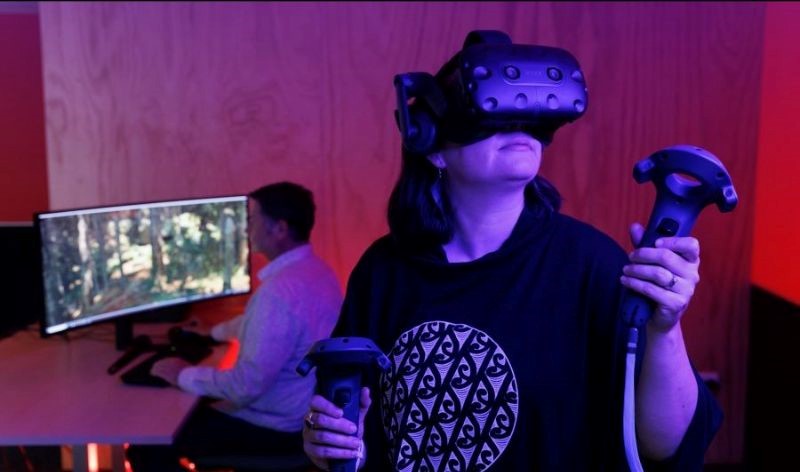
Innovative Virtual Reality Training Tool Supporting Thinning Decisions
¶ Overview
VR thinning training uses virtual reality simulation to teach forest machine operators the principles and practical skills of silvicultural thinning — the selective removal of trees to improve stand growth, health, and timber quality — in a safe, repeatable, and cost-free learning environment. Thinning is one of the most skill-intensive operations in plantation management because an operator must simultaneously control a complex harvesting machine, navigate without damaging residual trees, and apply a thinning prescription that may specify leaving certain species, spacing, or stem quality classes while removing others. Mistakes in a real stand cause irreversible damage: soil compaction, residual tree wounding, and prescription errors all reduce the long-term productivity of the crop. VR simulators reproduce a photorealistic forest environment — including tree populations modelled from real inventory data — and simulate the full machine cab with haptic controls, audio feedback, and accurate machine physics. Trainees can practise thinning a stand repeatedly under different prescriptions, receive immediate performance feedback on metrics such as residual spacing, tree damage rate, and cycle time, and progress through increasing difficulty scenarios. Leading simulator manufacturers including Komatsu Forest (with its Exceedo platform), Ponsse, and John Deere Intelligent Solutions have developed thinning training modules. In Australia, vocational training bodies such as Forestry Corporation NSW and state-based TAFE programs have explored VR simulation to address a persistent shortage of skilled harvesting machine operators, particularly relevant as experienced operators retire and recruitment from rural communities becomes harder. VR training also reduces the environmental and commercial risk associated with putting novice operators into production stands, and can be delivered at training centres or even on-site using portable headset-based systems.
¶ Assessment
Improves thinning decision-making while reducing training-related accident risk, offering indirect but meaningful productivity and safety benefits.
¶ Details
| Field | Value |
|---|---|
| Company | Forest Grower Research |
| Country | New Zealand |
| Type | Company |
| FWPA RD&E | 8.5 |