¶ Using 3 different robots in the forest
| Authors | Ehrlich-Sommer et al. |
| Country | University of Natural Resources and Life Sciences Vienna, Austria |
| Paper (PDF) | View paper |
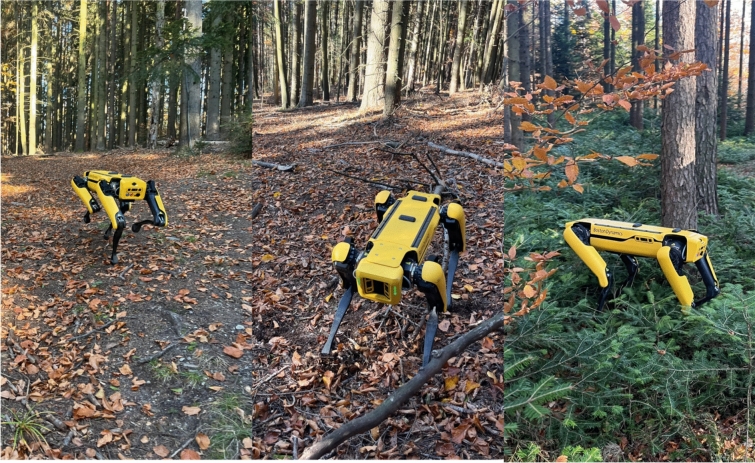
comparison of robot movement, physical exertion, system usability
0
¶ Overview
The concept of deploying three complementary robot types simultaneously in a forest environment — typically combining an aerial UAV for canopy-level sensing, a ground-based UGV (unmanned ground vehicle) for terrain-level operations, and a specialised manipulator or harvesting robot for direct tree interaction — represents an emerging multi-robot systems paradigm in precision forestry that seeks to leverage the distinct advantages of each platform class within a coordinated operational framework. In a representative deployment scenario, a fixed-wing or multirotor UAV first conducts a wide-area survey, generating a high-resolution map of the stand that identifies trees of interest — whether for harvest selection, pest inspection, or replanting target locations. This information is shared via a centralised mission management system to one or more ground robots, which navigate autonomously through the stand using the aerial map as prior knowledge, supplementing it with onboard SLAM as they encounter unmodelled obstacles. A third robot — such as a harvester head-equipped tracked vehicle, a planting robot, or a sampling arm mounted on a UGV — performs the direct intervention task guided by the combined aerial and ground data. Communication between platforms relies on mesh radio networks or direct peer-to-peer links, and task allocation algorithms distribute work to minimise total mission time while respecting battery, fuel, and payload constraints. Research into heterogeneous multi-robot forestry systems has been conducted at institutions including the University of Oulu (Finland), Luleå University of Technology (Sweden), and the University of Sydney's Australian Centre for Field Robotics (ACFR), where coordinated robot teams have been trialled in eucalypt and pine plantation environments. In Australia, the practical drivers include the need to reduce human exposure to dangerous harvesting and chemical application environments, improve the precision and speed of post-fire reforestation assessment and planting, and build the operational data density required for adaptive forest management under a changing climate.
¶ Details
| Field | Value |
|---|---|
| Company | Ehrlich-Sommer et al. |
| Country | University of Natural Resources and Life Sciences Vienna, Austria |
| Type | Paper |
| Year | 2025 |
| FWPA RD&E | 4.4 |