¶ Truck platooning
| Company | FP InModelvations |
| Country | Canada |
| Website | https://www.woodbusiness.ca/fpinModelvations-successfully-completes-truck-platooning-baseline-tests/ |
| Category | Logistics & mills interface › Remote sensing & mapping |
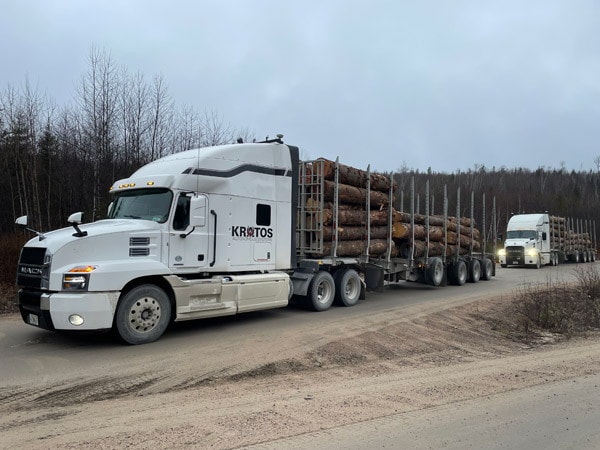
Off-highway truck platooning to counter labour shortage
¶ Overview
Truck platooning is a technology in which two or more heavy vehicles travel in a coordinated convoy at close following distances, with the trailing vehicles using vehicle-to-vehicle (V2V) communication, adaptive cruise control, and automated braking systems to electronically couple to the lead vehicle. By maintaining precise inter-vehicle gaps — typically between eight and fifteen metres at highway speeds — platooning reduces aerodynamic drag on following vehicles by up to 10–15%, delivering meaningful fuel savings and emissions reductions. In the context of timber and log transport, platooning holds significant potential for improving the efficiency and safety of log haul operations, which in Australia often involve long-distance road transport on highways connecting forest regions to mills or ports. Research and pilot programs in Europe and North America have demonstrated platooning with B-double and road train configurations similar to those used in Australian log haulage. The Volvo, Scania, and Daimler truck groups have all conducted large-scale platooning trials, with Volvo's work on autonomous transport systems particularly relevant given the brand's dominance in Australian forestry trucking. In Australia, the National Transport Commission and Austroads have investigated the regulatory and infrastructure requirements for platooning, and the technology is seen as a stepping stone toward fully autonomous road trains that could operate on dedicated forest haulage roads without a driver in every cab. Key challenges include the regulatory frameworks for reduced following distances on public roads, mixed-traffic interaction, and network connectivity in remote forest regions where mobile coverage is limited. Despite these challenges, truck platooning is increasingly viewed as a near-term, commercially viable pathway to reducing labour costs and improving safety in log transport, particularly for large integrated forestry operations with high-volume haul routes.
¶ Assessment
Enhances haulage efficiency and lowers driver risk through automation, though broader environmental risk benefits are Modelt strongly evidenced.
¶ Details
| Field | Value |
|---|---|
| Company | FP InModelvations |
| Country | Canada |
| Type | Company |
| FWPA RD&E | 4.3 |