¶ Thesis on semi-automating forestry machines
Description: The process of forest harvesting is highly mechanized in most industrialized countries,
with felling and processing of trees performed by technologically advanced forestry machines. However, the manoeuvring of the vehicles through the forest as well as the control
of the on-board hydraulic boom crane is currently performed through continuous manual
operation. This complicates the introduction of further incremental productivity improvements to the machines, as the operator becomes a bottleneck in the process. A suggested
solution strategy is to enhance the production capacity by increasing the level of automation. At the same time, the working environment for the operator can be improved by
a reduced workload, provided that the human-machine interaction is adapted to the new
automated functionality.
The objectives of this thesis are 1) to describe and analyse the current logging process
and to locate areas of improvements that can be implemented in current machines, and 2)
to investigate future methods and concepts that possibly require changes in work methods
as well as in the machine design and technology. The thesis describes the development
and integration of several algorithmic methods and the implementation of corresponding
software solutions, adapted to the forestry machine context.
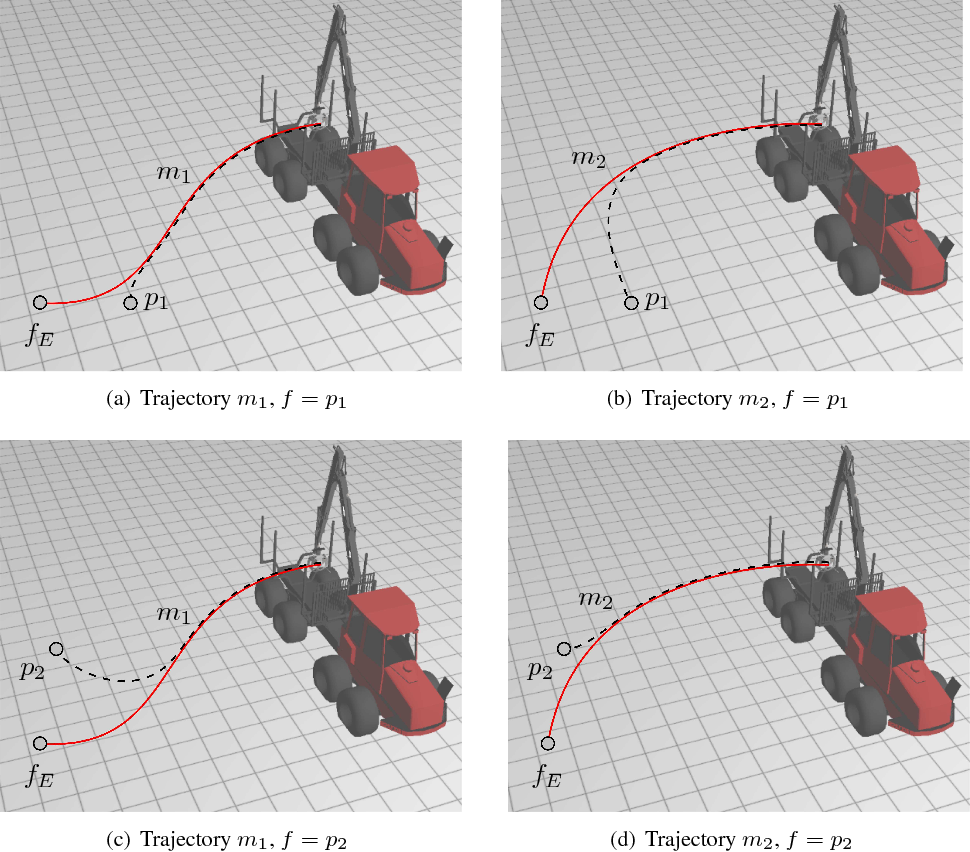
Following data recording and analysis of the current work tasks of machine operators,
trajectory planning and execution for a specific category of forwarder crane motions has
been identified as an important first step for short term automation. Using the method
of path-constrained trajectory planning, automated crane motions were demonstrated to
potentially provide a substantial improvement from motions performed by experienced
human operators. An extension of this method was developed to automate some selected
motions even for existing sensorless machines. Evaluation suggests that this method is
feasible for a reasonable deviation of initial conditions.
Another important aspect of partial automation is the human-machine interaction. For
this specific application a simple and intuitive interaction method for accessing automated
crane motions was suggested, based on head tracking of the operator. A preliminary interaction model derived from user experiments yielded promising results for forming the
basis of a target selection method, particularly when combined with some traded control strategy. Further, a modular software platform was implemented, integrating several
important components into a framework for designing and testing future interaction concepts. Specifically, this system was used to investigate concepts of teleoperation and virtual environment feedback. Results from user tests show that visual information provided
by a virtual environment can be advantageous compared to traditional video feedback
with regards to both objective and subjective evaluation criteria.
Snapshot: 0
Category: Autonomous Machinery & Robotics
FWPA RD&E: 4.4
¶ Details
| Company | Country | Type | Website | Available in Australia? | Year | Status | Remarks | TRL | Employees | Colour | Inventors | Patent Model. |
|---|---|---|---|---|---|---|---|---|---|---|---|---|
| Westerberg | Umea University, Sweden | Paper | Link | 2014 | Red |