¶ Testing human-robot interaction for 2 robots
| Authors | Schraik et al. |
| Country | University of Natural Resources and Life Sciences Vienna, Austria |
| Paper (PDF) | View paper |
0
¶ Overview
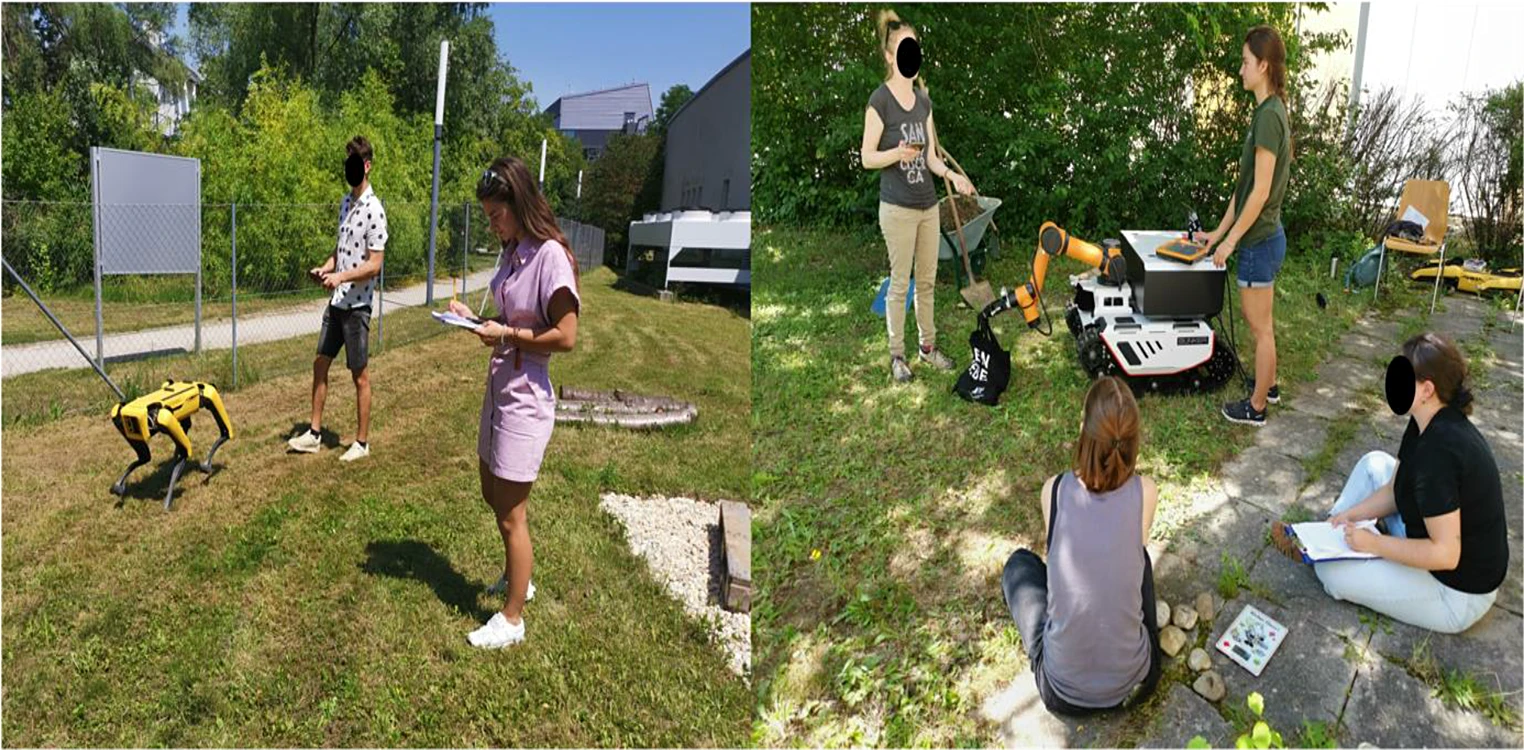
Human-robot interaction (HRI) testing for multi-robot systems is an emerging research area that examines how human operators effectively supervise, command, and collaborate with two or more semi-autonomous robots working simultaneously in complex environments such as forestry and logging operations. Unlike single-robot HRI, operating two robots introduces challenges of divided attention, workload management, and the need for operators to develop accurate mental models of multiple machines with distinct states, tasks, and spatial positions. Research in this domain typically employs simulation environments and physical testbeds to evaluate interface designs, task allocation strategies, and levels of autonomy that minimise operator cognitive load while maintaining safe and productive outcomes. In forestry automation, the scenario of a human supervisor overseeing two robotic harvesters, forwarders, or felling machines is increasingly plausible as autonomous ground vehicles advance toward operational deployment. Studies have examined metrics such as situation awareness, response time, error rates, and trust calibration when operators manage two robots under varying degrees of autonomy. User interface design is critical: effective dashboards must convey each robot's current task, position, obstacle detections, and exception alerts without overwhelming the operator. Research groups in Australia, Scandinavia, and North America — regions with active forestry robotics programs — have contributed to understanding how interface modality (screen-based, augmented reality, or voice), robot autonomy level, and operator training influence HRI performance in forestry-like settings. As the forestry industry moves toward reduced crew sizes and greater automation to address labour shortages and safety imperatives, validated HRI frameworks for multi-robot supervision will be essential to ensure that human oversight remains effective and that autonomous systems operate reliably within complex, dynamic forest environments.
¶ Details
| Field | Value |
|---|---|
| Company | Schraik et al. |
| Country | University of Natural Resources and Life Sciences Vienna, Austria |
| Type | Paper |
| Year | 2024 |
| FWPA RD&E | 4.4 |