¶ stereo camera for automated log grasping
| Authors | Semberg et al. |
| Country | Skogforsk (Research note) |
| Paper (PDF) | View paper |
| Category | Harvesting & Extraction › Remote sensing & mapping |
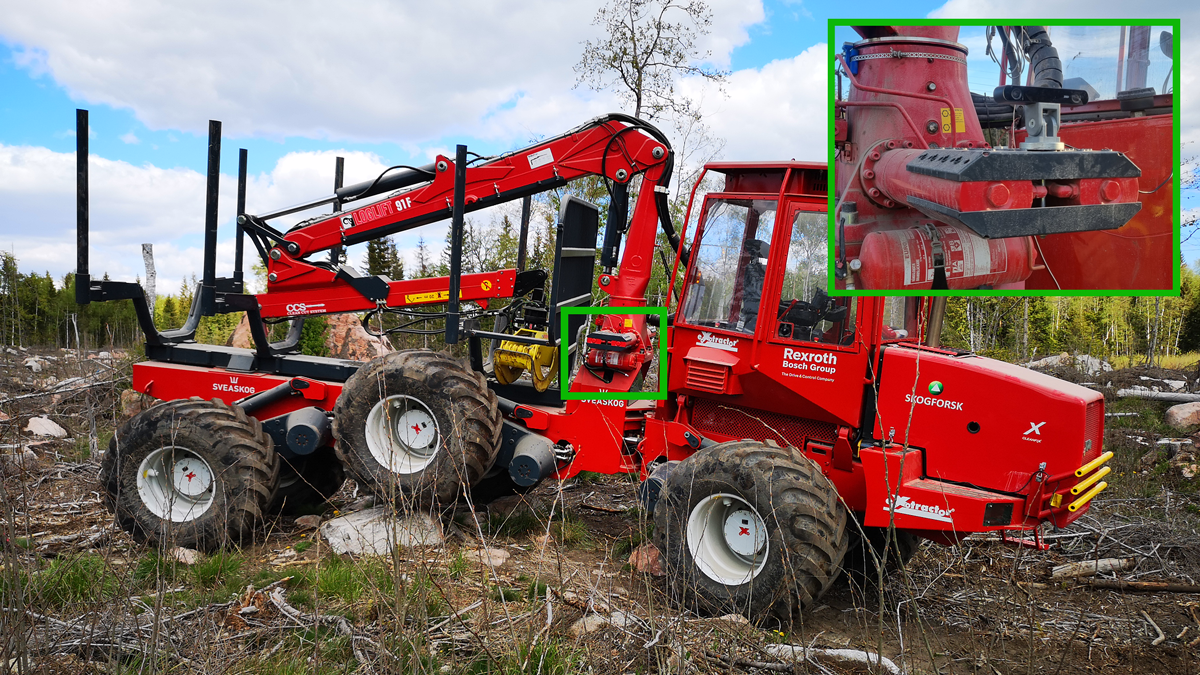
tested in full-scale, real-time operation: perhaps promising results in grasping accuracy
0
¶ Overview
Stereo camera systems for automated log grasping are machine vision technologies that enable forestry harvesters and log-handling equipment to perceive the three-dimensional geometry of logs and timber piles without manual operator guidance. The system works by mounting two calibrated cameras a fixed distance apart on the harvester head or crane, mimicking human binocular vision; the disparity between the two images is computed in real time to generate a dense depth map of the scene. Algorithms then identify individual log ends, estimate their positions and orientations in 3D space, and output target coordinates to the crane or grapple control system, allowing the machine to autonomously align and close the grapple around a selected log. Key processing stages include point-cloud segmentation to isolate log cross-sections from surrounding debris, circle-fitting or ellipse-detection to locate log centres, and collision-avoidance checks before the grapple is actuated. Research conducted at institutions such as Luleå University of Technology and within EU-funded precision-forestry projects has demonstrated sub-centimetre grasping accuracy under typical forest-yard lighting conditions, even when logs are wet, bark-covered, or irregularly stacked. In the Australian forestry context, where mixed-species hardwood and softwood operations in states such as Victoria, Tasmania, and Queensland involve varied log diameters and irregular terrain, stereo-vision grasping reduces operator fatigue during repetitive log-sorting cycles at landings and log yards. The technology also supports productivity gains in plantation operations managing radiata pine or blue gum, where high-cycle-rate processing demands consistent and rapid grapple placement. Integration with broader harvester automation — including harvester heads equipped with length and diameter sensors — positions stereo camera grasping as a foundational component of fully autonomous or teleoperated forestry systems being trialled globally as of the mid-2020s.
¶ Assessment
Increases handling efficiency and reduces operator fatigue and error, with moderate operational risk-reduction benefits.
¶ Details
| Field | Value |
|---|---|
| Company | Semberg et al. |
| Country | Skogforsk (Research note) |
| Type | Paper |
| Year | 2024 |
| FWPA RD&E | 4.4 |
| Remarks | 0.0 |
| Case Studies | 0 |