¶ Skogforsk study on virtual reality remote-controlled crane operations
Recommended Technology
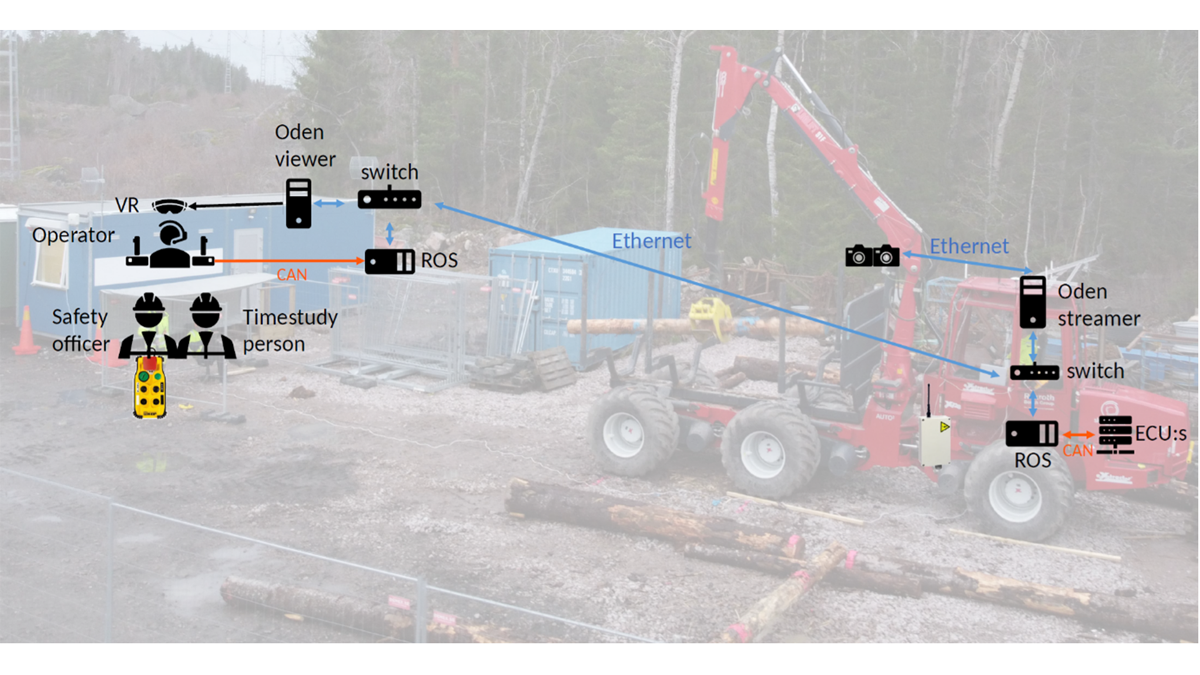
Description: The study was performed using the full-scale forwarder prototype Xt28, where remote control is implemented with ROS (Robot Operating System), and the video transmission system for the VR headset is provided by Voysys. To study the effects of greater delays, a function was implemented in ROS to introduce artificial delay. The teleoperation system’s minimal inherent delay is 100 ms when operating over the network. The impact of delay on the teleoperation system was also tested at 150 ms and 200 ms and compared with crane operation from the machine cabin. The machine’s internal delay in the hydraulics and control units also contributes to the overall delay.
The operators achieved surprisingly comparable performance regardless of delay or whether they were operating remotely or from the cabin. However, at the higher delays of 150 ms and 200 ms, operators reported that the crane sometimes felt as if it got "stuck" during rapid adjustments. At delays between 200 ms and 600 ms, the experience shifted to where the crane became impossible to control normally. For comparison, latency in a 4G connection is usually under 50 ms.
The VR experience was generally positive, with the lack of vibrations and noise being especially appreciated. However, the stereoscopic vision was not entirely perfect, and in some situations, the crane's position occasionally appeared to shift suddenly by 1–2 meters.
Snapshot: 0
Category: Safety & Worker Assistive Technologies
FWPA RD&E: 4.4
¶ Details
| Company | Country | Type | Website | Available in Australia? | Year | Status | Remarks | TRL | Employees | Colour | Inventors | Patent Model. |
|---|---|---|---|---|---|---|---|---|---|---|---|---|
| Rossander et al. | Skogforsk (Research Note) | Paper | Link | 2024 | Red |