¶ Resistograph
| Company | Rinntech |
| Website | https://rinntech.info/products/resistograph/ |
| Category | Planning & Inventory › Remote sensing & mapping |
¶ Overview
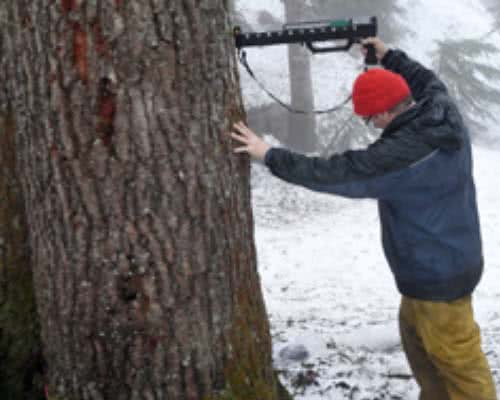
A resistograph is a precision diagnostic instrument used to assess the internal condition of standing trees, wooden poles, and timber structures by measuring the resistance encountered as a fine drill bit penetrates the wood. The device consists of a small-diameter needle (typically 1.5–3 mm) driven into the wood at a constant rotational speed and feed rate by a motor, while a sensor records the resistance to penetration as the needle advances. This resistance profile is plotted as a waveform on a paper strip or stored digitally, producing a "resistance profile" or "resistograph trace" that reveals internal features such as annual ring boundaries, resin pockets, decay cavities, insect galleries, and cracks that would not be visible from the exterior. Healthy, dense wood produces high and consistent resistance readings, while decayed, hollow, or soft wood generates markedly lower resistance values. The instrument is minimally invasive — leaving only a small-diameter drill hole — making it practical for use on heritage trees, urban street trees, and utility poles where destructive sampling is not acceptable. In forestry and arboriculture, resistograph assessments are used to evaluate structural integrity before harvesting decisions on high-value stems, to guide retention of veteran trees in conservation management, and to assess decay in trees adjacent to infrastructure. In Australia, resistograph testing is used by urban councils and arborists for tree risk assessment under AS 4970 (Protection of Trees on Development Sites), and by timber product certifiers assessing the soundness of large-dimension logs from old-growth or regrowth eucalypt forests. The technology complements other non-destructive assessment tools including sonic tomography and electrical resistance tomography, often used together when a comprehensive internal condition profile is required.
¶ Assessment
Useful for improving wood utilisation through Modeln-destructive detection of internal defects, reducing structural and quality-related risks.
¶ Details
| Field | Value |
|---|---|
| Company | Rinntech |
| Type | Company |
| FWPA RD&E | 4.1 |