¶ Forstreich TR300 remote-controlled felling wedge
Recommended Technology
| Website | https://www.forstreich.de/produkt/16242/?lang=en |
| Category | Harvesting & Extraction › Felling & processing |
safety/harvesting equipment
¶ Overview
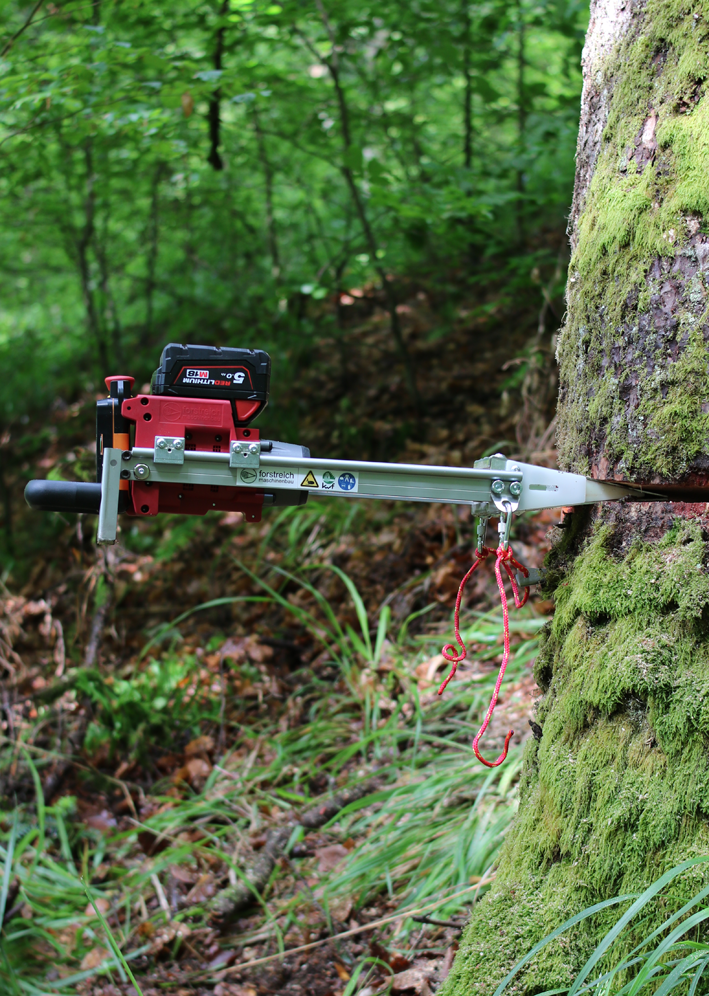
The TR300 is a remote-controlled felling wedge system designed to improve the safety and precision of directional tree felling in both forestry harvesting and arboriculture operations. Conventional felling wedges are driven manually into the back-cut of a felled tree using a sledgehammer or plastic mallet to guide the direction of fall and prevent the saw bar from being pinched; this places the operator in close proximity to the falling tree at the moment of greatest hazard. The TR300 replaces manual wedge driving with a battery-powered or pneumatic actuator that can be inserted into the back-cut and then activated remotely by the chainsaw operator from a safe distance via a handheld wireless controller, allowing the operator to step back out of the fall zone before the tree begins to move. The system typically incorporates a robust aluminium or reinforced polymer wedge body with an integrated piston or inflatable bladder mechanism capable of generating sufficient lateral force to steer large-diameter stems. TR300-type remote wedge systems have gained attention in European countries with strict occupational health and safety standards for manual chainsaw operators, and have also been evaluated by forestry safety organisations in Australia and New Zealand where chainsaw felling remains a significant cause of serious workplace injuries. In Australian plantation thinning and selective harvesting operations where mechanised harvesting heads cannot access terrain or stand conditions require manual chainsaw work, remote felling wedge technology represents a practical engineering control that reduces exposure to struck-by and crushing hazards without requiring major changes to established felling techniques. Training and certification for the device can be integrated into existing chainsaw operator competency frameworks.
¶ Assessment
A speedy solution to felling in diffcult situations and the reduction of menual wedging. Strong risk reduction through human safety, reducing exposure to closeness during felling and chainsaw hazards.