¶ Skogforsk Troëdsson Forestry Teleoperation Lab remote operations
Recommended Technology
| Authors | Rossander et al. |
| Country | Skogforsk (Research Modelte) |
| Paper (PDF) | View paper |
| Category | Harvesting & Extraction › Felling & processing |
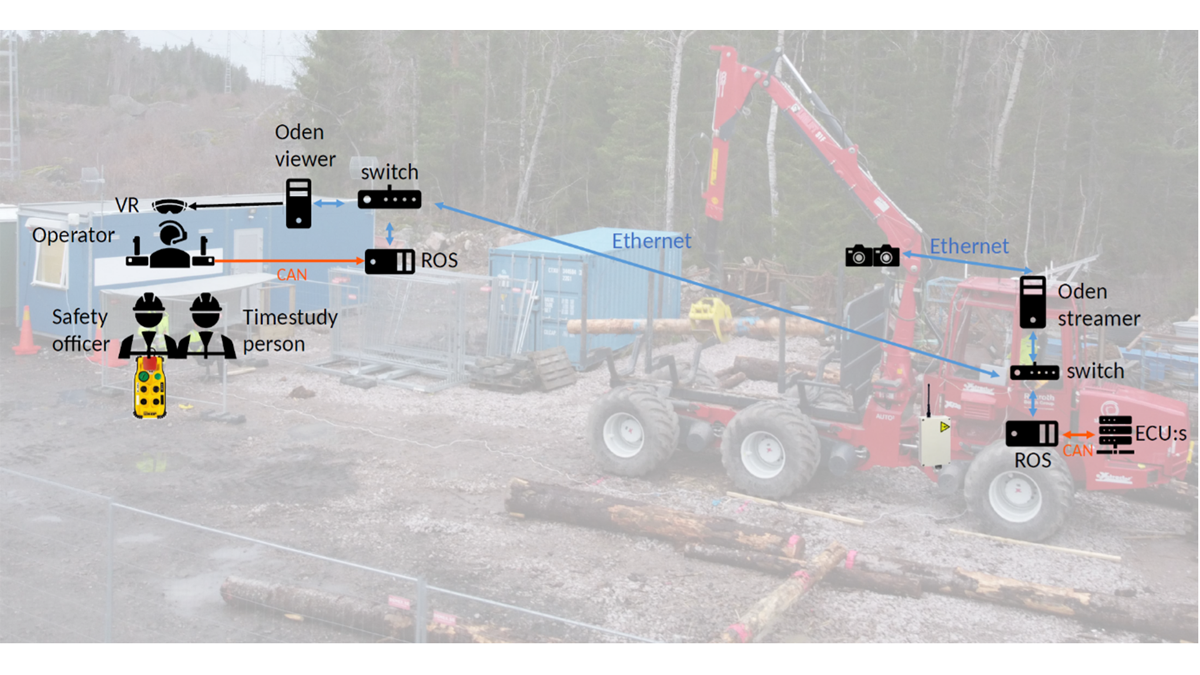
Teleoperation not significantly influenced by signal delays. biggest influence: steroscopic /3D vision with VR not as good as cabin view
0
¶ Overview
The Troëdsson Forestry Teleoperation Lab, operated by Skogforsk, has developed a comprehensive suite of operator‑assist and teleoperation technologies that extend human capability in forestry without removing the operator from the control loop. These systems combine advanced sensing, visualisation, and control technologies to support operators in performing complex tasks more safely and consistently, particularly in environments characterised by steep terrain, limited visibility, and high physical demands. Rather than pursuing full autonomy, the programme focuses on augmenting operator performance, ensuring that human judgement remains central while repetitive, high‑risk, or precision‑dependent elements are assisted or stabilised.
A key feature of the Troëdsson Lab’s work is the integration of enhanced visualisation and situational awareness tools, including multi‑camera systems, stereoscopic or virtual‑reality (VR) views, and real‑time environmental sensing. These technologies allow operators - whether in‑cab or remote - to better interpret their surroundings, supporting more accurate crane control, improved placement of loads, and safer navigation in dense or obstructed forest conditions. Complementary assistance systems such as motion smoothing, crane stabilisation, and machine‑levelling support reduce operator fatigue and variability in task execution, particularly during repetitive operations like forwarding or loading.
The lab also explores teleoperation and remote‑assist models, where operators can control or supervise machines from safe, off‑machine environments. This has significant implications for reducing exposure to hazards such as vibration, noise, heat, and slope instability, while also enabling more flexible workforce models. Importantly, these systems are designed to scale from assistance to higher levels of automation, providing a practical transition pathway rather than a disruptive shift. As such, the Troëdsson Forestry Teleoperation Lab represents a bridge between conventional machine operation and future autonomous systems, delivering immediate gains in safety, precision, and workforce sustainability while building the technical and organisational foundation for more advanced automation.
For Australian forestry, these operator assistance tools are well aligned with plantation and native forest operations, steep terrain, heat exposure, and workforce shortages. They offer a credible, near‑term way to lift safety, productivity, and workforce sustainability without relying on full machine autonomy.
¶ Details
| Field | Value |
|---|---|
| Company | Rossander et al. |
| Country | Skogforsk (Research Modelte) |
| Type | Paper |
| Year | 2024 |
| FWPA RD&E | 4.4 |