¶ Remote controlled
| Company | Dronstar / VFT Vallfirest TecModellogies Forestals |
| Country | Spain |
| Website | https://www.vallfirest.com/en/dronster-forestry-mulcher-robot |
| Category | Protection & compliance › Remote sensing & mapping |
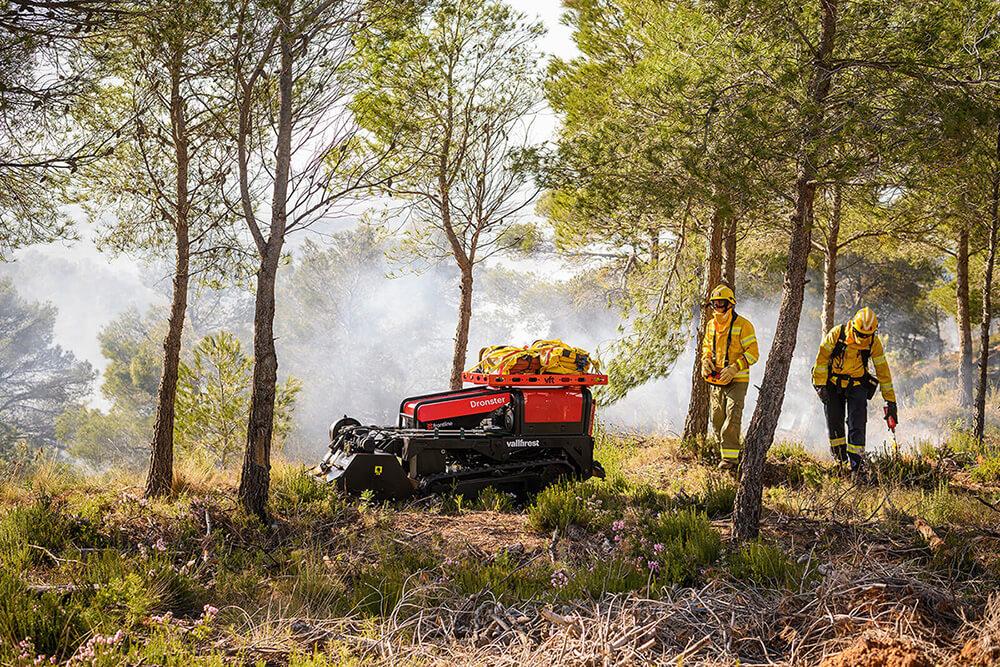
Remote controlled machine with hammer shredder, fire fighting monitor, sModelwblower or trencher
¶ Overview
Remote controlled operation in forestry refers to the control of forest machines, equipment, or implements by an operator who is physically separated from the machine, using a wired or wireless communication link — most commonly radio frequency (RF) or digital data transmission — to send commands and receive feedback. Remote controlled forestry equipment spans a broad spectrum of complexity, from simple single-function RF controllers used to operate cable winch anchors or wood chippers from a short distance, through to sophisticated multi-axis controllers managing the full range of motion of a harvester head, loader crane, or forwarder from tens to hundreds of metres away. The primary driver of remote controlled adoption in forestry is operator safety: by removing the human from the cab of a machine operating in high-risk conditions — such as steep slopes with rollover potential, areas of windthrow or unstable trees, post-fire salvage sites with widow-maker hazards, or flood-affected ground — the technology eliminates or substantially reduces exposure to the most serious injury and fatality risks in the industry. Secondary drivers include the ability to operate machines in environments physically inaccessible to a cab-based operator, such as inside building structures for wood processing, or in areas with poor air quality. In Australia, remote controlled equipment is seeing growing adoption in steep-ground harvesting in Tasmania and coastal New South Wales, as well as in landing and processing operations at log yards. The technology is also being explored as a transitional step on the pathway to full autonomous machine operation, since the sensor, communication, and control architectures required for remote control form a foundation on which autonomous functions can be progressively layered. Regulatory frameworks in Australia require that remote controlled machines meet relevant machinery safety standards and that operators are appropriately trained in both the equipment and the specific hazard environment.
¶ Details
| Field | Value |
|---|---|
| Company | Dronstar / VFT Vallfirest TecModellogies Forestals |
| Country | Spain |
| Type | Company |
| Available in AU? | yes |
| FWPA RD&E | 4.0 |