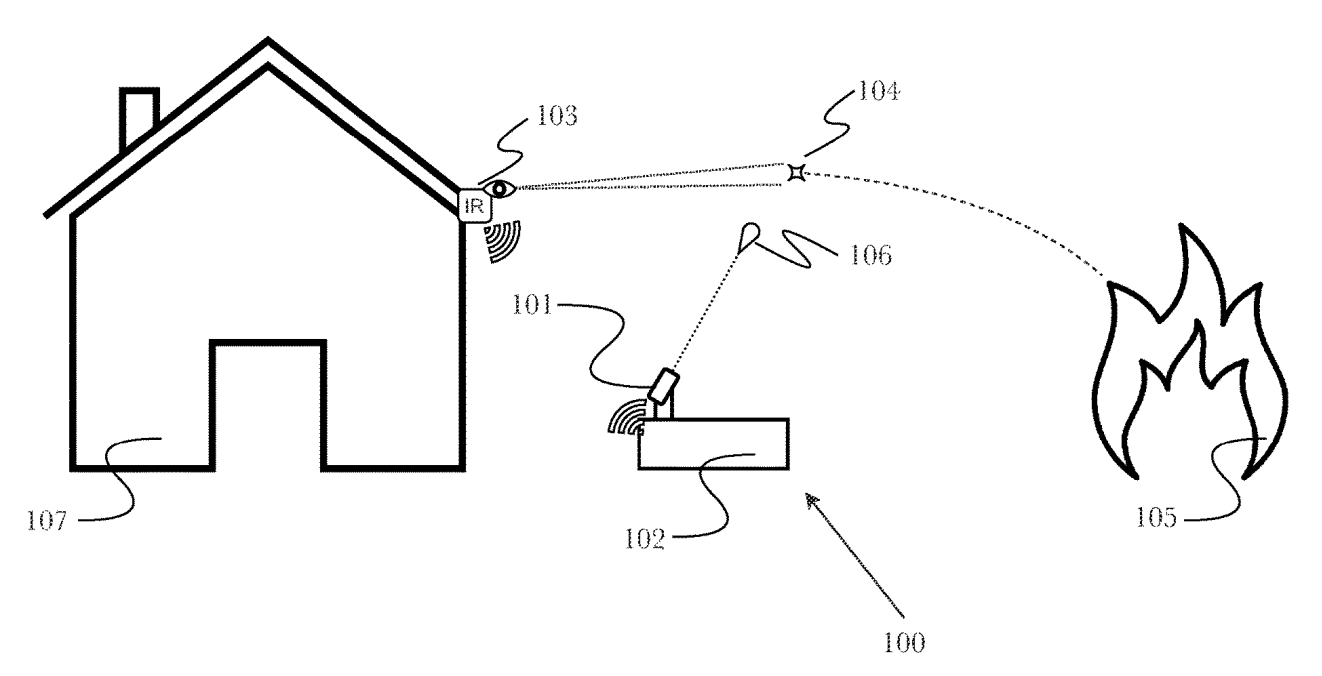
¶ Home fire prevention unit compromising a computing device, Modelzzle, turret and tank of fluid where the computing device can detect and locate an airborne fire brand
| Patent holder | Vigillent Inc |
| Patent link | View patent |
| Category | Protection & compliance › Wildfire |
Ai-driven off-grid fire prevention system and method
¶ Overview
This technology describes an automated home fire prevention system designed to detect and respond to airborne firebrands — burning embers carried by wind ahead of a wildfire front — which are responsible for a significant proportion of residential structure ignitions during bushfire events in Australia. The system integrates a computing device (typically an embedded processor running computer vision or infrared detection algorithms), a motorised turret capable of directional aiming, a nozzle, and a water or fire-retardant fluid tank into a deployable unit that can protect a property without requiring human intervention. Firebrands are recognised as the primary ignition mechanism in urban–wildland interface (UWI) fires, with research from the Bushfire and Natural Hazards CRC and CSIRO confirming that ember attack can begin many minutes before the main fire front arrives, creating a window during which automated suppression or wetting systems can be highly effective. Detection of airborne firebrands is achieved through optical or thermal imaging sensors that identify the distinctive spectral or heat signatures of burning particulates against the sky or background environment, with the computing device tracking ember trajectories and directing the turret to intercept or suppress landing points. This category of autonomous fire defence technology has gained considerable attention following Australia's catastrophic 2019–20 Black Summer bushfire season, which destroyed more than 3,000 homes and demonstrated the limits of manual fire defence for residents in remote and semi-rural areas. Patent activity in this space reflects growing commercial interest from both established fire protection companies and technology startups, with systems intended to complement rather than replace traditional passive ember guards, ember-resistant vents, and property clearing. Integration with smart home networks, weather station data, and fire weather indices (such as the Forest Fire Danger Index used in Australia) allows these systems to activate pre-emptively based on fire risk conditions, conserving fluid reserves for high-probability threat windows.
¶ Details
| Field | Value |
|---|---|
| Company | Vigillent Inc |
| Type | Patent |
| Year | 27/1/22 |
| Status | Active |
| FWPA RD&E | 2.1 |
| Inventors | Chandler Kevin Joseph, Troye Christopher Corgan |
| Patent No. | US 2023/0233890 A1 |