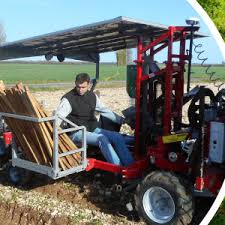
A GPS transplanter is a precision planting machine used primarily in nursery, agricultural, and increasingly forestry operations, which integrates Global Positioning System (GPS) receivers — and often Real-Time Kinematic (RTK) GPS for centimetre-level accuracy — with automated or semi-automated transplanting mechanisms to place seedlings at precisely georeferenced locations across a prepared site. In forestry applications, GPS transplanters are deployed in plantation establishment workflows where uniform and accurately spaced planting is essential for stand productivity, harvesting efficiency, and resource management. The machine records the GPS coordinates of each planted seedling as it is placed, creating a georeferenced database of every planted stem that can subsequently be used to track individual tree growth through repeated remote sensing observations, target spot herbicide and fertiliser application by GPS-guided sprayer vehicles, and support precision thinning operations. In mechanised plantation establishment systems, GPS transplanters may be mounted on tractor or purpose-built planting machine platforms, with onboard guidance systems steering the vehicle along pre-planned planting rows loaded from a GIS, alerting operators when spacing deviates from specification, and automatically adjusting planting depth based on real-time soil sensor feedback. In the Australian context, GPS transplanting technology is applied in softwood and hardwood plantation establishment in regions such as the Green Triangle (Victoria/South Australia), the NSW Softwood Zone, and in Queensland hardwood plantations, where large-scale mechanised planting campaigns benefit from accurate spatial records to support operational planning and regulatory compliance. Integration with drone-based post-planting survival assessments allows rapid identification and replanting of failed spots, improving first-rotation stocking rates and reducing establishment costs.
| Field |
Value |
| Company |
Leger SAS |
| Country |
France |
| Type |
Company |
| FWPA RD&E |
4.4 |