¶ Forest Vegetation Simulator (Software, Training, Support)
| Company | U.S. Department of Agriculture |
| Country | USA |
| Website | https://www.fs.usda.gov/managing-land/forest-management/fvs |
| Category | Planning & Inventory › Remote sensing & mapping |
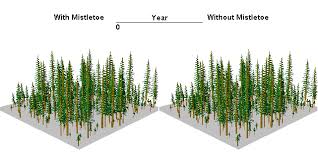
forest growth simulation model. It simulates forest vegetation change in response to natural succession, disturbances, and management. I
¶ Overview
The Forest Vegetation Simulator (FVS) is an individual-tree, distance-independent growth and yield modeling system developed and maintained by the United States Department of Agriculture (USDA) Forest Service. Originally conceived in the 1970s and continuously updated since, FVS simulates the development of forest stands over time by projecting diameter, height, and crown growth for each individual tree in a stand inventory, applying mortality functions, and optionally simulating the effects of management interventions — including thinning, prescribed burning, harvesting, and planting — on stand structure and composition. The simulator is organised around geographic variants, each calibrated with regional species-specific growth coefficients derived from permanent plot networks; variants cover most forest types across the continental United States and have been adapted for use in British Columbia and other jurisdictions. FVS interfaces with a suite of extension modules (called Event Monitor, Suppose, and various fire and insect extensions) that allow users to model fuel loading, fire behaviour, bark beetle impacts, carbon stocks, and economic outcomes within a single integrated workflow.
Although FVS was developed for North American forest types, its architecture and open-source availability have made it a reference model and methodological benchmark for forest growth simulation globally, influencing the design of analogous tools used in Australian plantation management. Training and support for FVS are provided through the USDA Forest Service's Forest Management Service Center, which offers workshops, online documentation, and a user community forum. In the Australian context, FVS concepts underpin discussions of individual-tree growth modeling in eucalypt and pine plantations, and the system is frequently referenced in comparative studies evaluating simulation platforms. Australian equivalents and adaptations — including models embedded within the FRAMES (Framework for Resources and Environmental Management with Spatial Enablement) and ESRI-linked decision-support systems — draw on the FVS paradigm of linking inventory data, growth equations, and scenario-based management scheduling to support long-term yield forecasting and carbon accounting under the Australian National Carbon Offset Standard (ANCOS) and related frameworks.
¶ Assessment
Offers long-term strategic value through scenario modelling, lowering decision uncertainty and supporting better rotation planning.
¶ Details
| Field | Value |
|---|---|
| Company | U.S. Department of Agriculture |
| Country | USA |
| Type | Company |
| FWPA RD&E | 7.2 |