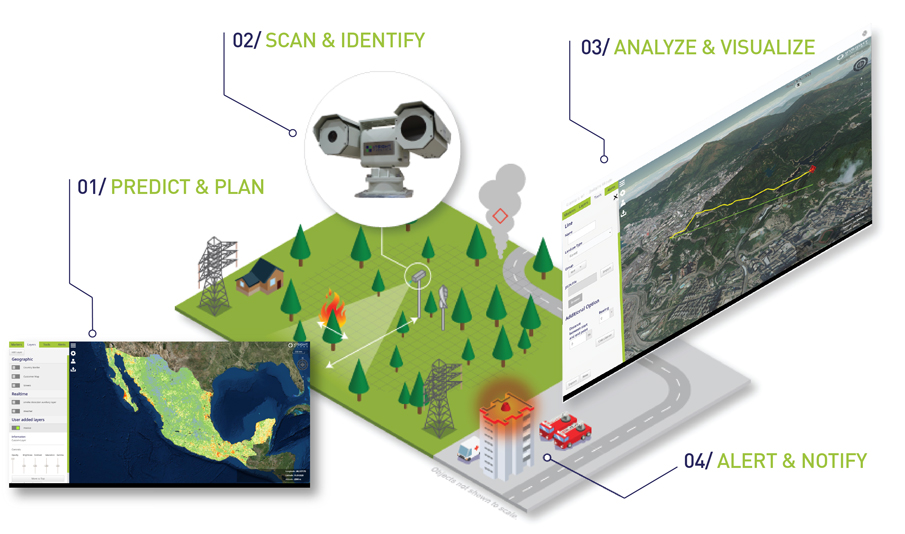
A wildfire detection system is an integrated network of sensors, cameras, algorithms, and communication infrastructure designed to identify the ignition or early spread of uncontrolled fire in forested or bushland environments as rapidly as possible, enabling land managers and emergency services to dispatch suppression resources before a fire escapes initial attack. Modern systems combine multiple detection modalities to reduce both false-positive and false-negative rates: fixed pan-tilt-zoom cameras equipped with smoke-detection computer vision algorithms, satellite-based thermal anomaly products such as NASA's FIRMS (Fire Information for Resource Management System) and the Australian Bureau of Meteorology's Himawari-8 derived fire alerts, aerial and drone-based infrared sensors for targeted surveillance of high-risk areas, and ground-based IoT sensor arrays that monitor temperature, relative humidity, wind speed, and atmospheric particulates. AI-driven image analysis platforms — including systems such as ALERTWildfire in the United States and analogous solutions deployed across south-eastern Australia — process live camera feeds and flag smoke plumes within minutes of ignition, automatically triangulating the fire location from multiple camera angles and transmitting georeferenced alerts to dispatch centres. In Australia, the extreme fire weather driven by hot, dry summers and episodic drought conditions — exemplified by the 2019-2020 Black Summer bushfire season that burned more than 18 million hectares — has accelerated investment in detection technology by state governments, the Australian Institute of Disaster Resilience, and forest industry bodies. Commercial plantation managers and state forest agencies in Victoria, New South Wales, and South Australia now integrate wildfire detection data with their operational dashboards, automatically triggering pre-planned response protocols, alerting harvesting crews, and adjusting daily operating conditions against real-time Fire Danger Rating information, significantly reducing the window between ignition and effective suppression response.
| Field |
Value |
| Company |
Insight Robotics |
| Country |
Hong Kong |
| Type |
Company |
| Employees |
~20 |
| FWPA RD&E |
2.2 |