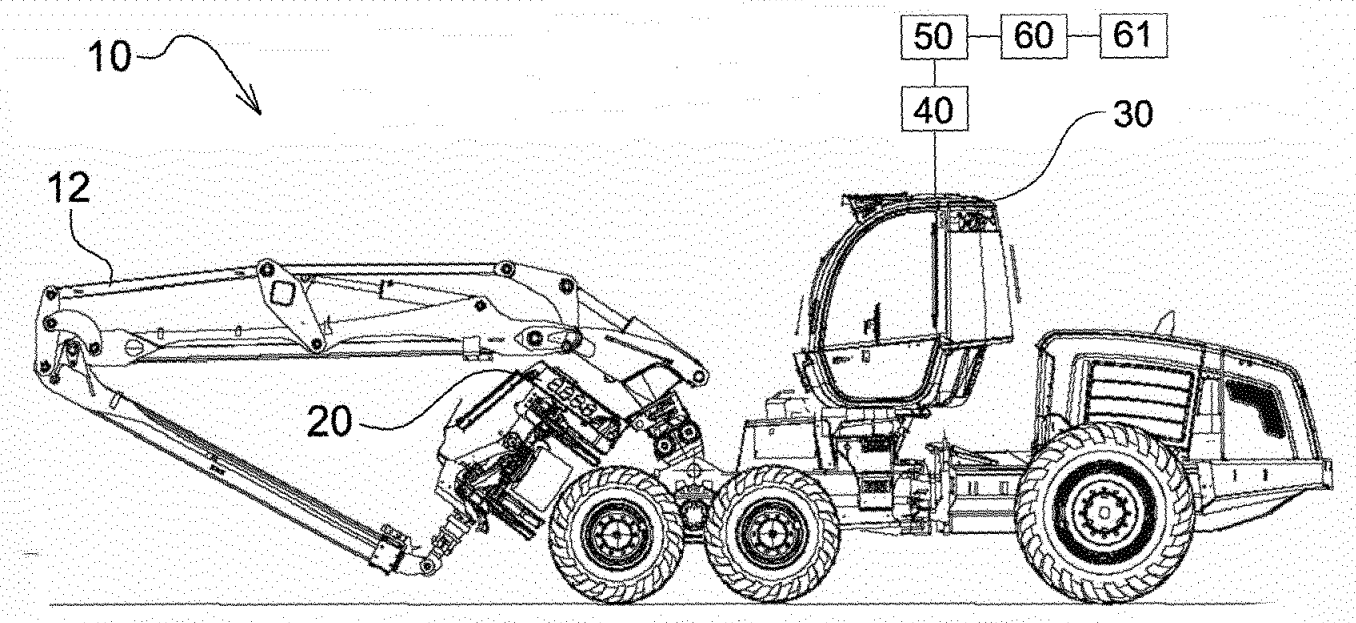
¶ Vehicle comprising a tree detection device to detect trees in the forest area and a vehicle position device to detect position of vehicle
| Patent holder | Deere & Co |
| Patent link | View patent |
| Category | Planning & Inventory › Remote sensing & mapping |
Method for measuring and analyzing a forest area for a forestry vehicle
¶ Overview
A vehicle equipped with a tree detection device and a vehicle position device represents a key enabling technology for autonomous and semi-autonomous forestry operations. Such systems integrate sensors — commonly LiDAR, stereo cameras, or structured-light scanners — mounted on harvesting or forwarding machines to continuously map surrounding trees in real time. The tree detection component identifies individual stems, estimates their diameter at breast height, and determines their spatial layout relative to the machine. The position device, typically a fusion of GNSS receivers, inertial measurement units (IMU), and odometry, determines the machine's precise location within the stand even under dense canopy where satellite signals are degraded. Together, these subsystems feed a onboard processing unit that can support path planning, collision avoidance, and selective harvesting decisions without requiring constant operator input. Research programs in Scandinavia — particularly at Skogforsk in Sweden and at Finnish forest technology institutes — have advanced prototype harvesters and forwarders that use this sensor fusion architecture to navigate autonomously between marked stems. In Australia, where plantation forestry in regions such as the Green Triangle, East Gippsland, and the Timor plantations of south-west Western Australia operates on relatively uniform radiata pine and blue gum estates, the technology is particularly promising. The structured geometry of plantation rows aids tree detection algorithms, and the commercial pressure to reduce labour costs and improve safety on steep or remote terrain provides strong economic motivation. Patent literature from major OEMs including John Deere, Komatsu Forest, and Ponsse describes specific implementations of tree-detection-plus-positioning architectures, reflecting the industry's shift toward machine intelligence. As autonomous capabilities mature, these integrated vehicle systems are expected to underpin fully unmanned harvesting cycles, reducing exposure to occupational hazards and enabling around-the-clock operations in Australian plantation and native forest contexts.
¶ Details
| Field | Value |
|---|---|
| Company | Deere & Co |
| Type | Patent |
| Year | 45629 |
| Status | Pending |
| FWPA RD&E | 7.3 |
| Inventors | Palmroth Mikko, Siltanen Vesa, Kaarnametsa Johannes |
| Patent No. | EP 4616703 A1 |