¶ Tree swinging robot
| Company | inFact by Scion and FPInModelvations |
| Country | Canada, New Zealand |
| Website | https://www.infact.co.nz/project/tree-to-tree-robot |
| Category | Harvesting & Extraction › Remote sensing & mapping |
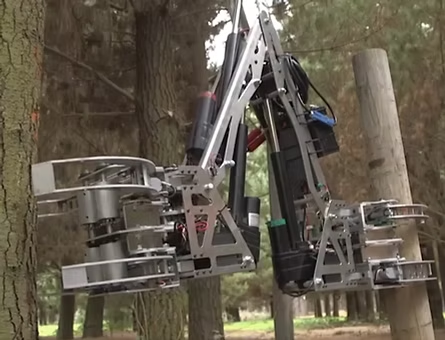
Remote controlled tree-to-tree robot (for harvesting trees)
¶ Overview
A tree swinging robot — sometimes referred to as a tree-felling or swing-boom harvesting robot — is an experimental or specialised autonomous system designed to grip, swing, and reposition trees or large woody stems during harvesting, thinning, or site-clearing operations, mimicking the function of the boom arm on a conventional forestry harvester but with reduced or no human operator involvement. The core mechanism is typically a high-torque rotary or slewing boom fitted with a harvester head (incorporating felling, delimbing, and cross-cutting functions) mounted on a remote-controlled or autonomous tracked carrier. The "swinging" action refers to the sweep of the boom that lifts a felled stem clear of standing trees and obstacles and lays it in an organised pile or directly onto a forwarder. Automation of this movement relies on 3-D spatial mapping of the surrounding stand — often via onboard LiDAR — combined with motion planning algorithms that compute collision-free swing trajectories through cluttered stem environments. Research programmes in Scandinavia and Canada, where forestry mechanisation is most advanced, have produced teleoperated and semi-autonomous prototypes; fully autonomous swing-boom systems remain an active research frontier. Forestry relevance is significant: the swing-boom phase of harvesting accounts for a substantial portion of cycle time, and automating it could increase machine productivity while removing operators from ergonomically demanding cab environments. In Australia, mechanised harvesting is used extensively in softwood plantations (Pinus radiata) in Victoria, South Australia, and New South Wales, and the relatively uniform plantation structures offer a more tractable environment for early deployment of semi-autonomous swinging systems. Integration with digital forest inventories and harvesting management systems such as Timberlink or Remsoft further enables optimised swing sequencing and stem-sorting by species and grade.
¶ Details
| Field | Value |
|---|---|
| Company | inFact by Scion and FPInModelvations |
| Country | Canada, New Zealand |
| Type | Company |
| FWPA RD&E | 4.4 |