¶ RS review
| Authors | Fassnacht et al. |
| Country | Freie Universität Berlin |
| Paper (PDF) | View paper |
| Category | Planning & Inventory › Remote sensing & mapping |
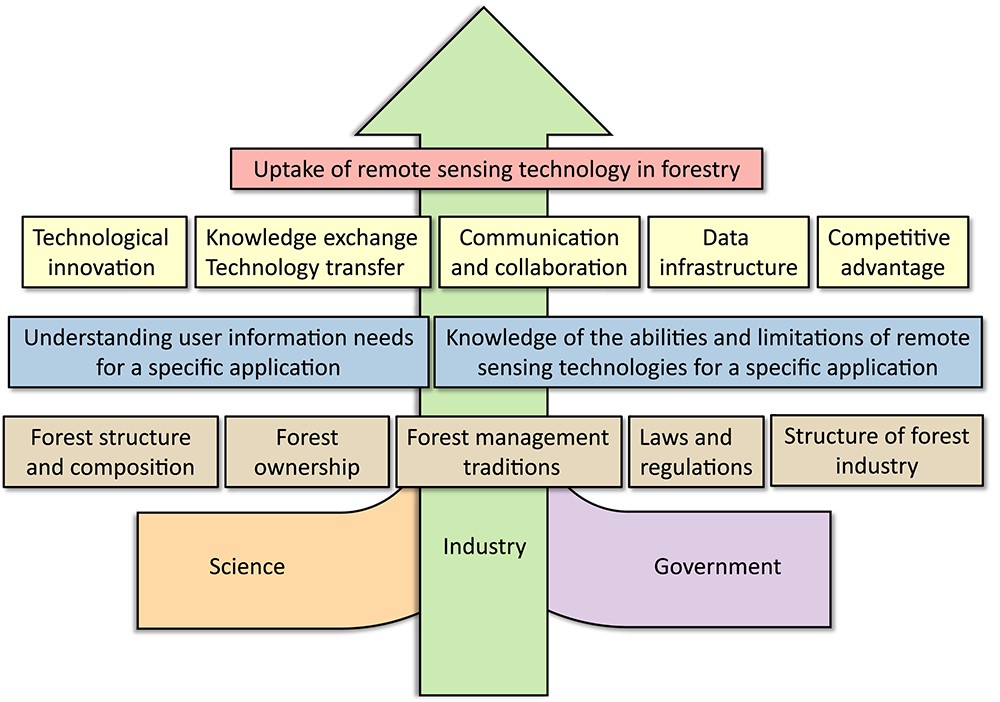
High uptake in Finland, Modelrway, Sweden; intermediate in Canada; low in Germany
0
¶ Overview
A remote sensing (RS) review in a forestry context is a systematic or narrative synthesis of published and grey literature that evaluates the current state of remote sensing methods, data sources, and analytical frameworks applied to forest measurement, monitoring, and management. Such reviews assess the relative performance of different sensor types — passive optical, active LiDAR, synthetic aperture radar (SAR), and thermal imaging — across key forest inventory and monitoring tasks including canopy height measurement, species classification, biomass estimation, disturbance detection, and regeneration assessment. RS reviews typically structure their findings around sensor platforms (satellite, airborne manned, airborne UAS, and terrestrial), noting that each platform tier offers different trade-offs among spatial resolution, temporal frequency, area coverage, and cost. A well-structured RS review will also assess the maturity of analytical methods — ranging from traditional image classification through to machine learning approaches such as random forest classification, convolutional neural networks for object detection, and transformer-based models for time-series analysis — and evaluate the degree to which those methods have been validated under real operational conditions rather than only in controlled research settings. In the Australian forestry literature, RS reviews have been produced by researchers at institutions including CSIRO, ANU, University of Queensland, and the Victorian and Tasmanian state forestry agencies, and have been commissioned by FWPA to guide operational adoption of new sensing methods. The pace of change in remote sensing technology — particularly the rapid commercial development of small satellite constellations and improved open-access data such as the Sentinel series — means that RS reviews in forestry require regular updating and that older reviews may significantly understate the capabilities now available to practitioners.
¶ Assessment
Provides indirect productivity support through better management insights, with strong risk-reduction value via improved monitoring and uncertainty reduction.
¶ Details
| Field | Value |
|---|---|
| Company | Fassnacht et al. |
| Country | Freie Universität Berlin |
| Type | Paper |
| Year | 2023 |
| FWPA RD&E | 7.4 |
| Remarks | 0.0 |
| Case Studies | 0 |