¶ Review Forest Robotics
| Authors | Oliveira et al. |
| Country | University of Porto / CRIIS, Portugal |
| Paper (PDF) | View paper |
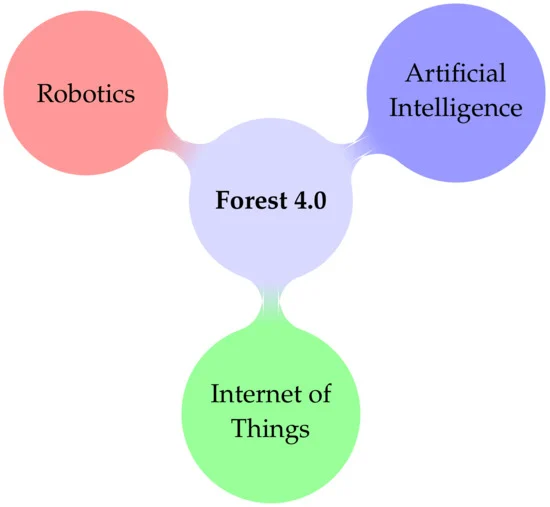
78% still in research phase; big concern: vegetation type interferes with navigation systems
0
¶ Overview
Forest robotics is a rapidly developing field of applied research that encompasses the design, development, and operational deployment of robotic systems — autonomous or semi-autonomous machines equipped with sensors, actuators, and computing — across the full range of forestry activities including planting, tending, harvesting, log transport, and monitoring. Review articles in this field synthesise progress across multiple research groups and industrial development programs, identifying common technical challenges and benchmarking the state of readiness of various robotic approaches. Key technical challenges identified in forest robotics reviews include terrain negotiation (steep, uneven, and variably surfaced ground), perception in complex three-dimensional canopy environments where GNSS signals are degraded and visual clutter is high, manipulation of irregularly shaped natural objects such as logs and seedlings, and robustness under outdoor environmental conditions including rain, dust, and temperature extremes. Reviews distinguish between different robotic form factors — wheeled, tracked, and legged platforms — and different levels of automation from teleoperated machines through to fully autonomous systems. In the harvesting domain, Scandinavian and Finnish research institutions have led developments in autonomous harvesters and forwarders, while planting robotics research has been active in both Europe and North America. Australian forest robotics research, while smaller in absolute scale, has been active at institutions including the Queensland University of Technology (QUT) and the University of Sydney, with work on autonomous navigation in plantation environments and UAV-based forest monitoring. International reviews consistently highlight the economic imperative driving forest robotics — shrinking rural workforces, rising labour costs, and safety imperatives — as the primary factors accelerating translation from laboratory prototypes to commercial deployments in the near-to-medium term.
¶ Details
| Field | Value |
|---|---|
| Company | Oliveira et al. |
| Country | University of Porto / CRIIS, Portugal |
| Type | Paper |
| Year | 2021 |
| FWPA RD&E | 4.4 |