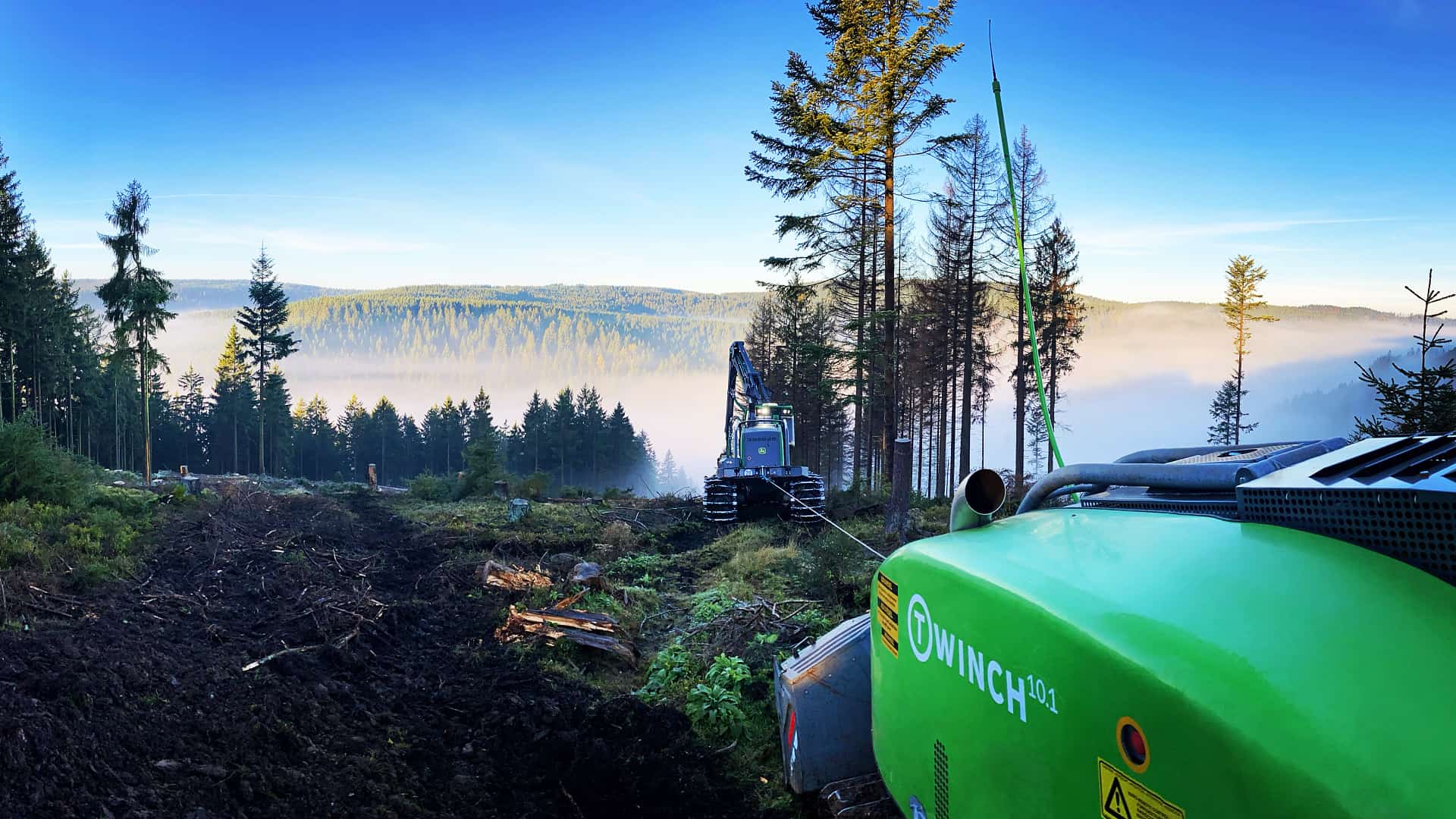
A remote harvest winch is a mechanised cable-based system used in steep-terrain forestry operations to extract logs from slopes where conventional ground-based machinery cannot safely or efficiently operate. The system consists of a powered winch unit — typically diesel or electric — anchored at a stable point such as a ridge line or a purpose-built tower, with a cable that extends down the slope to a choker or grapple attachment point at the log. Operators control the winch remotely using radio-frequency handsets or increasingly via digital control panels, allowing them to direct cable tension, speed, and direction from a safe distance rather than working in close proximity to moving lines and heavy timber. This remote-control capability is a critical safety advance over traditional manual winching, as cable-logging has historically been one of the most hazardous activities in forestry. Modern remote harvest winches may incorporate load-sensing feedback, automatic tension limiting, and GPS positioning to support precision placement of logs at landing zones. In European operations — particularly in Austria, Switzerland, and Slovenia — remote winch systems such as the Konrad Forsttechnik and Gantner-Polin designs are well established on slopes exceeding 45 degrees. In Australia, steep-terrain harvesting is relevant to operations in Tasmania, the Victorian Central Highlands, and parts of New South Wales and Queensland where plantation and native forest coupes occupy rugged terrain. The adoption of remote winch technology in Australia has been slower than in Europe partly due to different forest structures and harvesting conventions, but interest is growing as worker safety regulations tighten and as plantation operators in hilly regions seek productive alternatives to skyline crane systems. Research programs in Australia and New Zealand have examined the cost-effectiveness and safety benefits of remote winches as part of broader mechanised steep-terrain harvesting systems, with findings generally supporting their use where slope grades, timber volume, and worker safety considerations align.
| Field |
Value |
| Company |
Ecoforst |
| Country |
Austria |
| Type |
Company |
| FWPA RD&E |
4.4 |