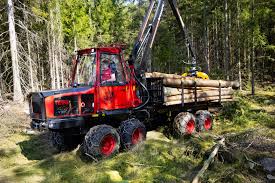
Remote forestry machines are forest harvesting, silviculture, or logistics machines that are designed or adapted to operate under remote control or autonomous guidance rather than requiring an operator to be physically seated in an onboard cab, enabling deployment in environments or conditions where conventional cab-based operation would be unsafe, impractical, or inefficient. The category includes a spectrum of configurations: machines operated by a remote human operator using a full teleoperation interface from a nearby or distant workstation; machines with limited autonomous functions such as GPS-guided tramline following or automatic boom control; and fully autonomous machines capable of planning and executing tasks such as harvesting, forwarding, or planting without real-time human intervention. Key technology components enabling remote forestry machines include robust wireless or cellular communication links with sufficient bandwidth and low latency for control and video feedback, onboard sensor suites (LiDAR, cameras, radar) for environment perception and obstacle detection, precise positioning systems (RTK-GPS or sensor fusion), and machine control software capable of translating high-level instructions into safe and productive machine movements across complex terrain. The development of remote forestry machines is most advanced in Scandinavian countries — particularly Sweden and Finland — where research institutions such as Skogforsk, machine manufacturers including John Deere Forestry, Komatsu Forest, and Ponsse, and forestry operators have collaborated on prototypes and commercial trials over several decades. The primary safety motivation — removing operators from the highest-risk environments in forestry, which remain among the most hazardous industries globally — is complemented by productivity arguments around extended operating hours, multi-machine supervision, and elimination of operator fatigue effects. In Australia, interest in remote forestry machines is growing among plantation operators and native forest contractors operating on steep, unstable, or post-fire terrain, with investment supported by industry safety bodies and the Forest Industry Safety Accord. The technology's trajectory points toward increasingly autonomous operations integrated with digital forest management systems, real-time inventory data, and automated logistics coordination.
| Field |
Value |
| Company |
Terri |
| Country |
Sweden |
| Type |
Company |
| FWPA RD&E |
4.4 |