¶ Paper on shaping the future of forestry in Germany through Augmented Reality
Recommended Technology
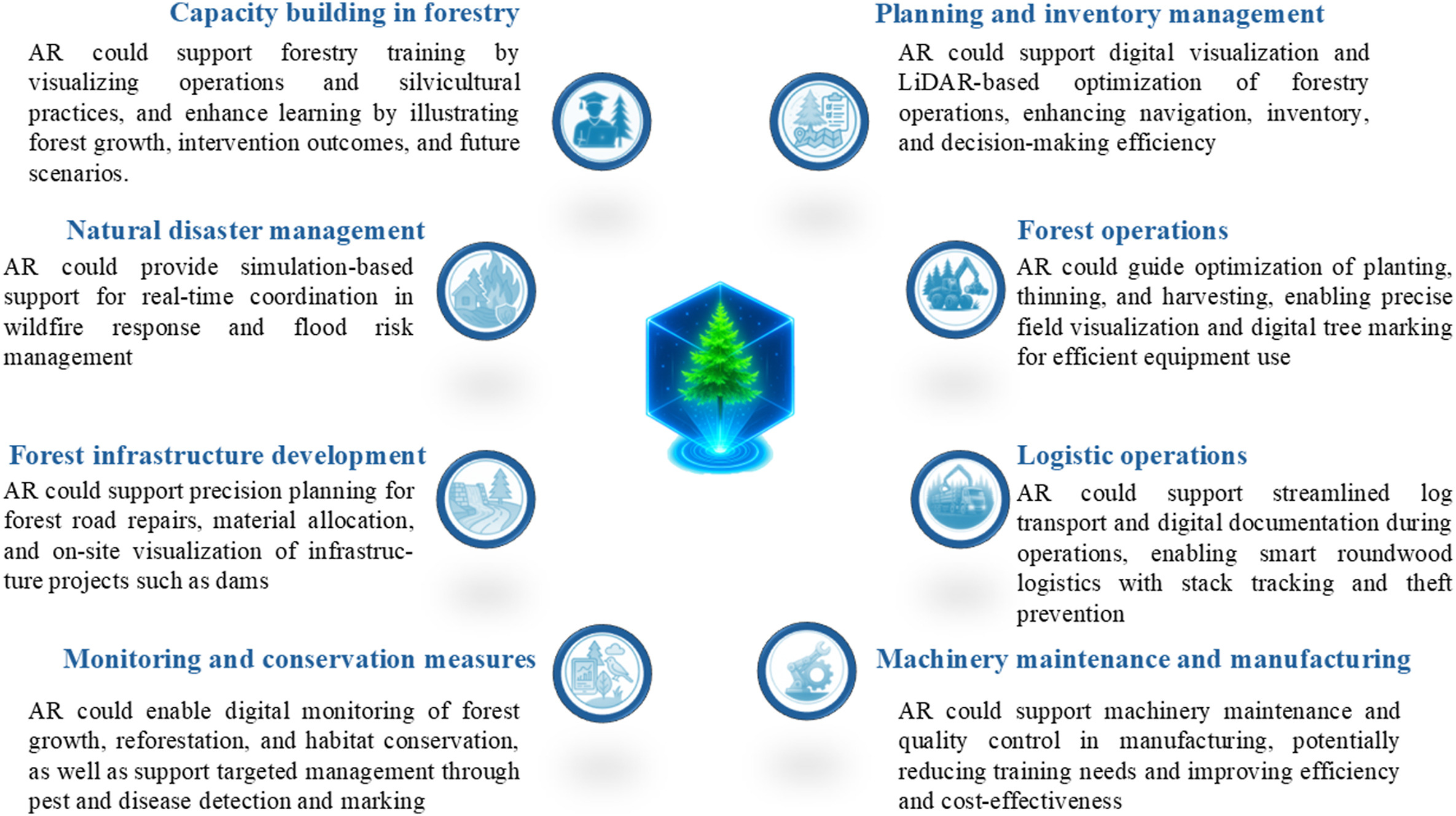
Description: “Shaping the future of forestry in Germany” (Miguel‑Díez & Purfürst, 2025) examines how augmented reality could be meaningfully integrated into forestry operations, moving beyond technical feasibility toward practical adoption. Using qualitative interviews with forestry practitioners and AR experts across multiple countries, the paper systematically identifies where AR is perceived to add real value and where it risks friction or rejection. Rather than proposing a single AR solution, the study frames AR as a context‑dependent decision‑support and visualisation interface, applicable across forest inventory, silvicultural operations, logistics, disaster and disturbance management, and stakeholder communication. The authors emphasise that AR’s promise lies in real‑time, spatially anchored interpretation of forestry data - particularly in situations where traditional 2D maps or office‑based tools fail to support rapid decision‑making in complex forest environments.
From a technology maturity perspective, the paper implicitly positions AR for forestry at TRL 5–6, consistent with current pilot‑level deployments. While AR hardware, particularly mixed‑reality smart glasses combined with high‑precision GNSS or RTK positioning, is technically capable, the study highlights significant barriers to operational readiness. These include device durability under forestry conditions, discomfort and cognitive overload for users, positioning accuracy under canopy, offline functionality, and resistance from practitioners when systems are perceived as intrusive or poorly aligned with workflows. Implementation costs are therefore driven less by hardware acquisition than by customised software development, usability design, and organisational change management.
An example of a currently available AR tool is the V‑Labs High‑Precision AR Platform for Field Operations. In a forestry context, V‑Labs demonstrates the potential of high‑precision, hands‑free AR where accurate spatial interpretation is critical, but also highlights practical constraints - including device weight, battery life, environmental robustness, and reliance on structured data pipelines - limiting broad deployment. As such, it is best viewed as a leading‑edge, execution‑grade tool suited to high‑value applications where precision, safety, and quality control justify increased complexity and cost. Operating at approximately TRL 7–8, the platform has been deployed in industrial pilots across infrastructure, utilities, and construction, though forestry applications remain emerging. Typical costs range from under $1,000 (VITURE Luma Ultra AR Glasses) up to $20,000 per unit, plus software and integration requirements.
For Australia, the relevance of this work lies in its strong alignment with large, remote forest estates and safety‑critical operations. The paper reinforces that AR does not directly improve forest outcomes on its own but acts as a force‑multiplier for planning accuracy, safety awareness, and communication, particularly when integrated with digital forest models, operator‑assist systems, and structured forestry data pipelines.
Category: Safety & Worker Assistive TechModellogies
FWPA RD&E: 8.4
¶ Details
| Company | Country | Type | Website | Available in Australia? | Year | Status | Remarks | TRL | Employees | Colour | Inventors | Patent Model. |
|---|---|---|---|---|---|---|---|---|---|---|---|---|
| Miguel-Díez and Parfürst | University of Freiburg | Paper | Link | 2025 | 0.0 | Orange |