¶ Mounders
| Company | Bracke Forest |
| Country | Sweden |
| Website | https://www.brackeforest.com/products/mounders |
| Category | Nursery & Establishment › Remote sensing & mapping |
¶ Overview
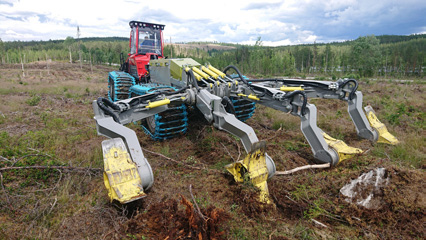
Mounders are specialised forestry site preparation machines or attachments used to create raised planting mounds — small elevated platforms of inverted or heaped soil and organic material — that improve the establishment conditions for seedlings in forest regeneration operations, particularly on sites with waterlogging, compacted soil, competing vegetation, or heavy slash (logging residue) that would otherwise impede planting and early seedling growth. The mounding process is typically carried out by a purpose-designed disc mounter or excavator-based mounder attachment, which inverts a plug of topsoil and humus to create a mound 20–50 cm above the surrounding ground surface; this elevated growing position improves drainage around seedling roots, reduces frost exposure in frost-hollow sites, positions roots in warmer and better-aerated soil layers, and physically separates the planted seedling from competing ground vegetation and the allelopathic compounds sometimes present in decomposing slash. Mounder designs include disc mounders (which use rotating concave discs to throw soil into mounds in a single pass, as seen in Scandinavian models from Bracke and Ahti), and excavator-bucket mounders widely used in steeper or more irregular terrain where wheeled machines cannot operate safely. In plantation forestry, mounding has been shown to significantly improve seedling survival and early height growth in wet or frost-prone sites, reducing the rotation time required to achieve commercial volumes and improving the uniformity of the planted crop. In Australia, mounding is used in plantation establishment on heavy clay soils and seasonally waterlogged sites, particularly in the Green Triangle region of South Australia and Victoria where radiata pine is the primary species, and in some native forest regeneration contexts where site rehabilitation after harvesting requires intensive intervention to achieve adequate stocking.
¶ Assessment
Supports faster, more reliable regeneration and reduces some manual-work risks, but concrete evidence of wider ecological risk mitigation remains limited.
¶ Details
| Field | Value |
|---|---|
| Company | Bracke Forest |
| Country | Sweden |
| Type | Company |
| FWPA RD&E | 4.4 |