¶ Machine mounted mounders for planting
| Company | Bracke Forest |
| Country | Sweden |
| Website | https://www.brackeforest.com/products/mounders |
| Category | Nursery & Establishment › Remote sensing & mapping |
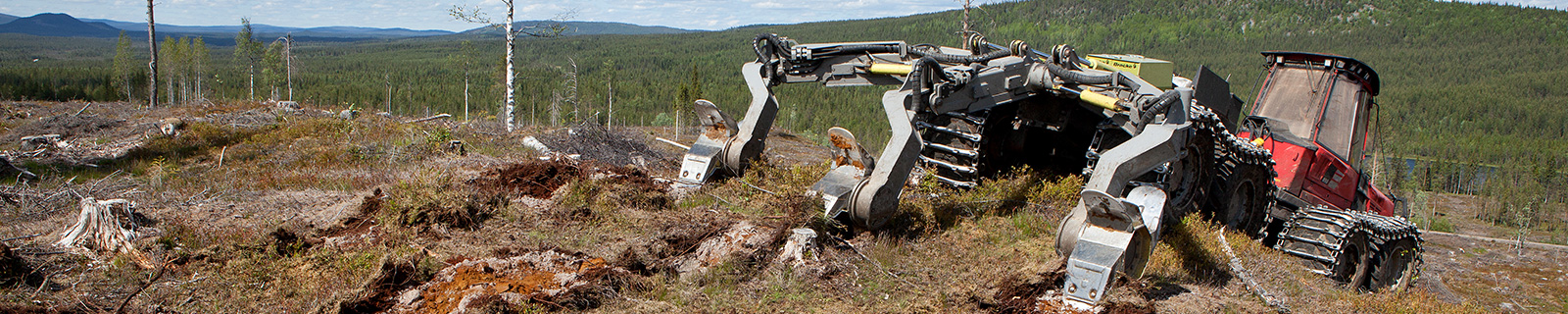
¶ Overview
Machine mounted mounders are site preparation implements attached to forest machines — most commonly excavators or purpose-built carriers — that create raised mounds of mineral soil on harvested coupes to improve conditions for seedling establishment. Mounding is a well-established silvicultural technique that elevates planting spots above the surrounding ground level, providing several key benefits: improved drainage to prevent root waterlogging, warmer soil temperatures that accelerate early root development, reduced competition from ground vegetation that colonises the lower inter-mound areas, and physical separation from slash residues that can harbour pathogens. A machine mounted mounder typically consists of a rotating disc, bucket, or blade assembly on the machine's arm or boom, which the operator uses to scrape, lift, and invert a turf of soil and organic material to form a mound at a target spacing across the cutover. Modern machine mounted mounders are increasingly integrated with GPS guidance systems that record the location of each mound, creating a spatial dataset that can later be used to guide mechanised or manual planting and subsequent stocking assessments. In Australian plantation forestry, site preparation is a critical investment that directly affects crop establishment success, and mounding is particularly valuable on wet or poorly drained sites such as those found in parts of south-eastern Australia and Tasmania. The use of machine mounted mounders replaces or supplements older disc-trenching and blade scarification techniques, offering more controlled and site-specific soil disturbance. As automation technology advances, some mounding heads are being developed with sensor feedback to adjust mound dimensions based on real-time soil condition data, moving toward precision site preparation that can optimise seedling survival rates across variable terrain.
¶ Assessment
A reliable system that prepares planting sites efficiently and improves early survival, though its broader ecological risk-reduction effects are limited.
¶ Details
| Field | Value |
|---|---|
| Company | Bracke Forest |
| Country | Sweden |
| Type | Company |
| FWPA RD&E | 4.4 |