¶ iLand - freely available research software for digital forest twins
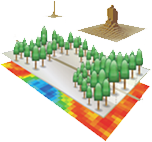
iLand (individual-based forest Landscape and Disturbance model) is an open-source, freely available forest landscape simulation model developed primarily by researchers at the University of Natural Resources and Life Sciences (BOKU) in Vienna, Austria, and the Technical University of Munich, designed to simulate the dynamics of forest ecosystems at both the individual tree and landscape scales over long time periods. The model operates by representing each tree in a simulated landscape as an individual agent characterised by species, size, position, and physiological state, and then simulating the processes of tree growth, competition for light and resources, mortality, regeneration, and disturbance — including fire, wind, bark beetle outbreaks, and harvesting — through time steps of one year. iLand's mechanistic foundation draws on established ecophysiological principles, making it capable of projecting forest responses to climate change scenarios, different management interventions, and disturbance regimes with a level of biological realism that simpler empirical yield models cannot match, positioning it as a key tool in the growing field of digital forest twins. A digital forest twin is a dynamic virtual replica of a real forest system, continuously updated with observed data, that can be used to test management hypotheses, forecast future states, and optimise operational decisions without physical intervention in the real forest. The software's open availability under academic licensing has fostered an international user community and a library of species parameter sets and landscape configurations covering European, North American, and increasingly Southern Hemisphere forest types. For Australian researchers and forest managers, iLand offers potential as a platform for simulating the dynamics of native eucalypt forests and plantation systems under projected climate change scenarios — particularly given Australia's heightened exposure to drought, heat stress, and altered fire regimes. The model has been used in published research examining carbon stock trajectories, biodiversity outcomes under alternative harvesting regimes, and the interaction of climate change with natural disturbance processes.