¶ iLand - free research software for digital forest twins
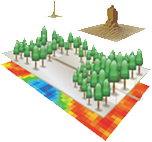
Description: iLand explicit simulates the principal adaptive agents in forest ecosystems, i.e., individual trees, over large areas. This scalability is achieved by (i) employing a pattern-based rendering of ecological field theory to efficiently model spatially explicit resource availability at the landscape scale, and by (ii) integrating local resource competition and physiological resource use via a hierarchical multi-scale framework.
iLand is conceived as a process-based model of the primary demographic processes in forest ecosystems, i.e. growth, mortality, and regeneration of trees. Seed dispersal in the landscape is simulated spatially explicit, and, in conjunction with a phenology-based establishment model, determines tree regeneration and species distribution. Productivity is derived at stand-level by means of a light-use efficiency approach, and downscaled to individuals via local light availability, accounting for adaptive behaviour of trees in response to their environment. Individual tree mortality is modelled based on carbon starvation, while spatially explicit modules of disturbance agents (wind, bark beetles, wildfire) can be deployed to simulate large-scale mortality events. The model thus harnesses approaches from community ecology, ecosystem ecology, and landscape ecology to address current questions of ecosystem stewardship and resilience. In addition, iLand integrates an agent-based model of forest management in order to dynamically address the interactions between forests and managers as coupled human and natural systems.
Category: Forest Modelling, Planning & Decision Support
FWPA RD&E: 7.5
¶ Details
| Company | Country | Type | Website | Available in Australia? | Year | Status | Remarks | TRL | Employees | Colour | Inventors | Patent Model. |
|---|---|---|---|---|---|---|---|---|---|---|---|---|
| iLand by TUM | Germany | Company | Link | Red |