¶ Harvester head
| Company | Bracke Forest |
| Country | Sweden |
| Website | https://www.brackeforest.com/products/felling-heads |
| Category | Harvesting & Extraction › Remote sensing & mapping |
¶ Overview
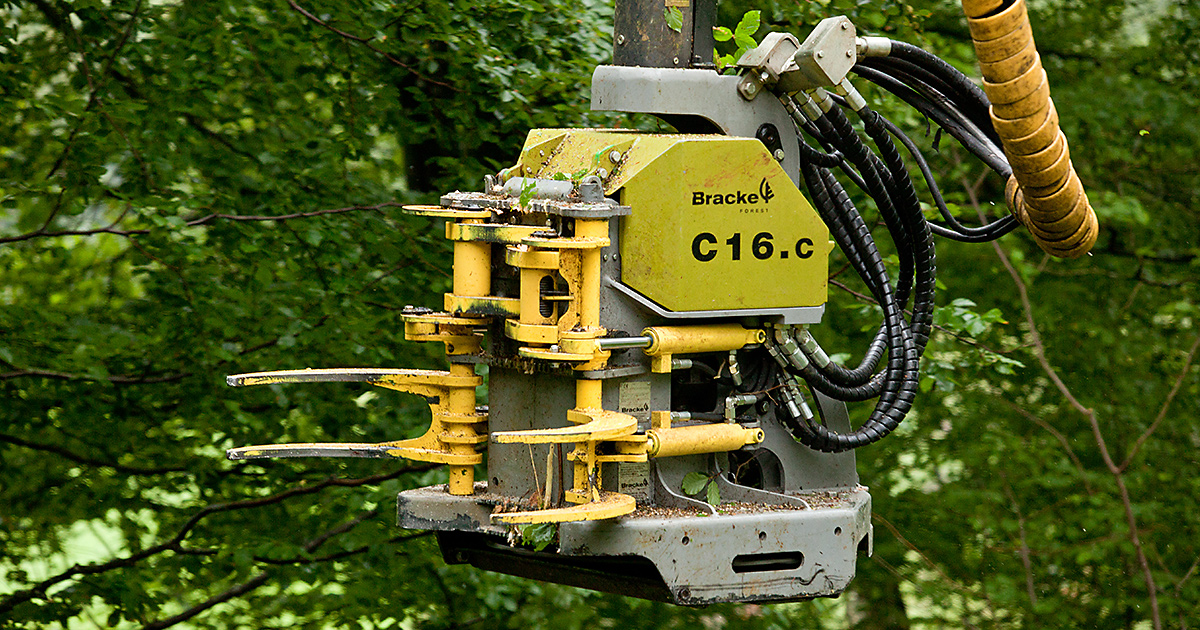
A harvester head is the active working attachment mounted on the end of a cut-to-length (CTL) forest harvesting machine, responsible for felling, delimbing, debarking, and cross-cutting trees into specified log lengths in a single integrated operation. The head is typically a hydraulically powered device attached to the boom of a purpose-built harvester or an adapted excavator base machine, and consists of a feed roller system that grips and propels the stem, a rotating saw unit for felling and bucking cuts, and delimbing knives or blades that strip branches as the stem is fed through the head. Modern harvester heads incorporate sophisticated onboard computers and measurement systems — including length-measuring wheels, diameter sensors, and sometimes quality sensors using acoustic or optical technology — that continuously track stem geometry as it is processed and automatically calculate optimal bucking patterns to maximise log value recovery against pre-loaded price matrices and product specifications. Leading manufacturers of harvester heads include Ponsse, John Deere (Waratah), Komatsu Forest, Logset, SP Maskiner, and Kesla, with head sizes ranging from small models suited to first thinnings of 100–200 mm DBH trees through to large felling heads capable of processing stems over 800 mm in diameter. In Australian plantation forestry, harvester heads are the dominant harvesting technology in mechanised CTL operations across softwood and hardwood estates, with operators selecting head models matched to the stem size profile and log product mix of their specific stands. Precision bucking — the ability to cut logs to millimetre accuracy at economically optimal positions along the stem — is one of the highest-value functions of modern harvester heads, and integration with stem quality prediction models that flag defects such as forking, sweep, or rot is an active area of technological development in the industry.
¶ Assessment
A productive mechanised system that increases felling efficiency and improves operator safety, though broader environmental risk reduction is Modelt clearly demonstrated.
¶ Details
| Field | Value |
|---|---|
| Company | Bracke Forest |
| Country | Sweden |
| Type | Company |
| FWPA RD&E | 4.4 |