¶ Forest Stem Extraction and Modeling (FoSEM): A LiDAR-Based Framework for Accurate Tree Stem Extraction and Modeling in Radiata Pine Plantations
| Authors | Ibraham et al. |
| Country | australia |
| Paper (PDF) | View paper |
| Category | Planning & Inventory › Remote sensing & mapping |
0
¶ Overview
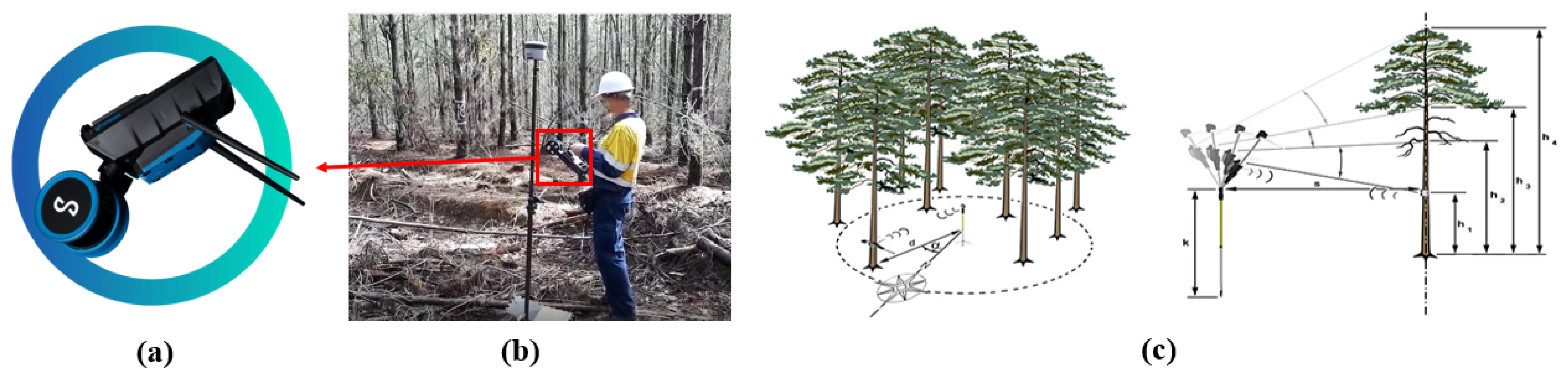
FoSEM (Forest Stem Extraction and Modeling) is a specialised computational framework developed to automate the extraction and three-dimensional geometric modeling of individual tree stems from terrestrial or mobile LiDAR point clouds acquired within plantation forests, with demonstrated application to radiata pine (Pinus radiata) stands in Australia and New Zealand. The framework addresses one of the most challenging steps in automated forest inventory: accurately isolating individual stem point clusters from dense, overlapping point clouds that include ground returns, understorey vegetation, branches, and canopy foliage, then fitting precise geometric primitives — typically cylinders or taper-curve models — to the isolated stem points to derive merchantable volume, taper functions, and stem-quality metrics. FoSEM employs a pipeline that typically includes ground filtering, normalisation to a height-above-ground reference, slice-based or voxel-based stem detection, RANSAC (Random Sample Consensus) or least-squares cylinder fitting, and hierarchical stem reconstruction to handle occluded or partially sampled stems. The result is a per-tree dataset of DBH, height, stem straightness, and volume estimates that can feed directly into growth models, harvest-yield predictions, and mill-supply planning tools.
Radiata pine is the dominant plantation species in Australia, covering approximately 750,000 hectares primarily in New South Wales, Victoria, South Australia, and the Australian Capital Territory, making it an ideal and commercially important subject for automated stem-analysis tools. Traditional inventory methods rely on manual calliper measurements and height poles sampled across a small fraction of the stand, introducing sampling uncertainty that FoSEM-style automated approaches can substantially reduce by measuring every detectable stem within a scan footprint. Research evaluating LiDAR-based stem extraction in radiata pine has demonstrated DBH estimation errors below 2 cm RMSE under favourable scanning conditions, with ongoing work focused on improving performance in dense mid-rotation stands where stem occlusion is high. Integration of FoSEM outputs with existing forest management information systems and harvester head measurement data represents a pathway toward fully digital, continuously updated plantation inventories that reduce reliance on periodic manual cruises.
¶ Details
| Field | Value |
|---|---|
| Company | Ibraham et al. |
| Country | australia |
| Type | Paper |
| Year | 2024 |
| FWPA RD&E | 7.3 |