¶ Forest growth models under climate change
| Authors | Boukhris et al. |
| Country | University of Tuscia, Italy |
| Paper (PDF) | View paper |
| Category | Planning & Inventory › Remote sensing & mapping |
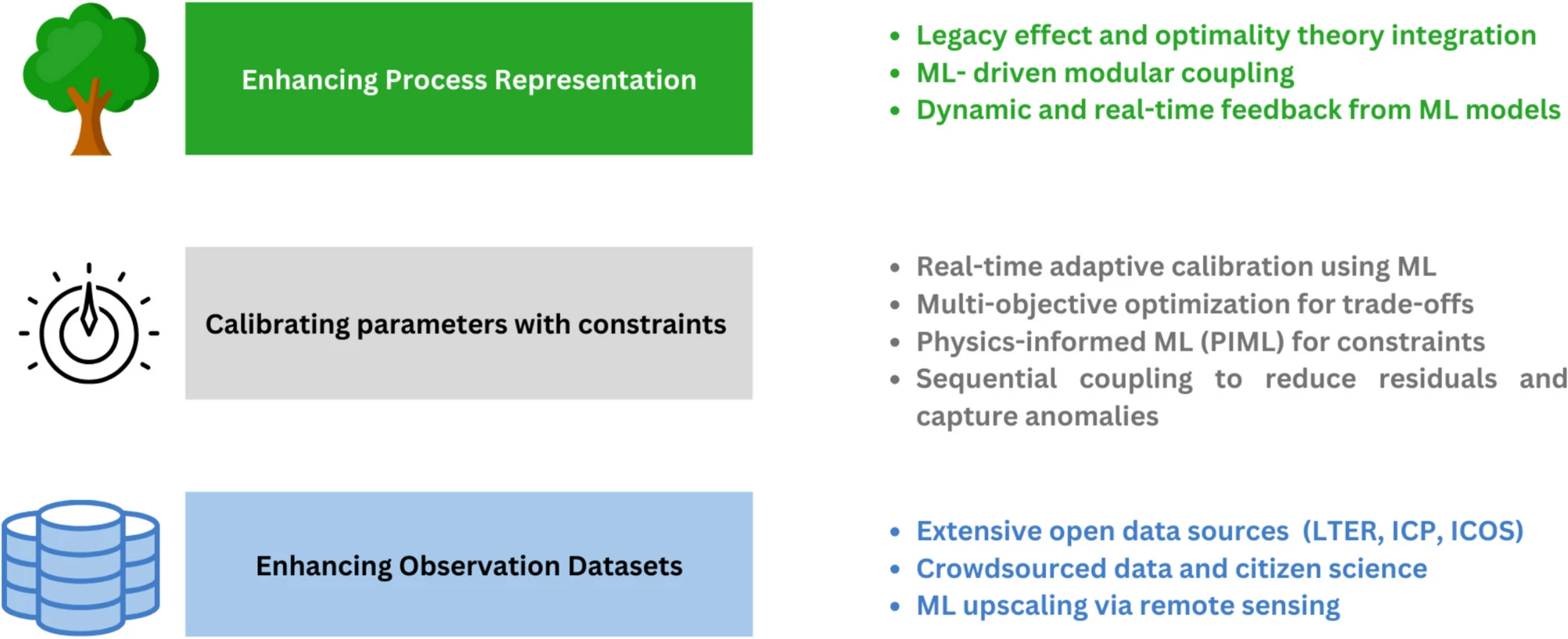
enhancing process replication, calibration parameters, enhancing observation datasets
0
¶ Overview
Forest growth models under climate change are modelling frameworks that incorporate projected shifts in temperature, precipitation, atmospheric CO2 concentrations, and extreme weather events to predict how forest productivity, species composition, and ecosystem function will evolve over coming decades. Standard empirical growth models, calibrated against historical climate conditions, progressively lose predictive accuracy as climatic conditions shift outside the range of observed data; addressing this limitation requires either the statistical recalibration of empirical models using climate-sensitive parameters or the adoption of process-based models that mechanistically simulate the physiological responses of trees to environmental drivers such as vapour pressure deficit, soil water availability, frost frequency, and elevated CO2. Widely used climate-sensitive growth modelling approaches include the 3-PG model with climate forcing inputs, the SORTIE-ND spatially explicit individual-tree simulator, iLand, and coupled vegetation-climate models embedded within Earth system frameworks. Climate change effects on forest growth are complex and context-dependent: elevated CO2 can stimulate photosynthesis and improve water use efficiency in some species (CO2 fertilisation), while increased drought frequency and severity, higher temperatures exceeding thermal optima, and increased disturbance from fire, wind, and pest outbreaks can simultaneously reduce productivity and increase mortality. In Australia, climate projections under IPCC scenarios indicate hotter and drier conditions across much of the continent's plantation forestry regions, posing significant risks to radiata pine, eucalypt, and other commercially grown species. Research programs at institutions including the University of Melbourne, CSIRO, and the Australian National University are developing climate-sensitive growth models and scenario planning tools to help Australian forest managers adapt rotation lengths, species mixes, stocking densities, and silvicultural regimes to maintain productivity and resilience under 1.5°C–4°C warming trajectories.
¶ Details
| Field | Value |
|---|---|
| Company | Boukhris et al. |
| Country | University of Tuscia, Italy |
| Type | Paper |
| Year | 2025 |
| FWPA RD&E | 1.8 |