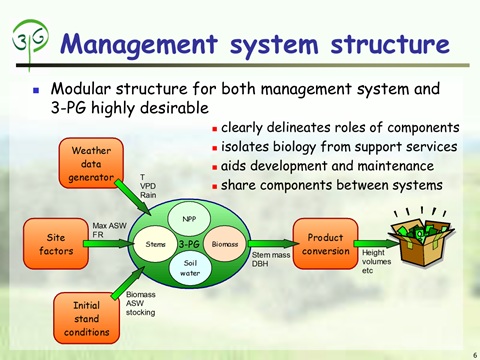
The absorbed radiant energy to biomass production framework is a process-based approach to modelling forest growth that links the interception and absorption of solar radiation by forest canopies to the production of organic biomass through photosynthesis. Rooted in the radiation use efficiency (RUE) concept formalised by Monteith in the 1970s, this class of model holds that the dry matter production of a plant canopy is proportional to the amount of photosynthetically active radiation (PAR) it absorbs, modified by a species- and condition-dependent conversion efficiency factor. In practice, absorbed PAR (APAR) is calculated as a function of incoming solar radiation, the leaf area index (LAI) of the canopy, and canopy light extinction coefficients derived from stand structure measurements or remote sensing. Biomass increments are then allocated among foliage, stems, branches, and roots according to empirically or mechanistically derived partitioning ratios that vary with tree age, site conditions, and resource availability. The 3-PG (Physiological Principles Predicting Growth) model, widely used in Australian and global plantation forestry, explicitly implements this radiation-driven growth framework, making it one of the most practically applied examples of the APAR-to-biomass paradigm. Remote sensing has greatly enhanced the operationalisation of these models by providing spatially continuous estimates of APAR and LAI from satellite platforms such as Landsat, Sentinel-2, and MODIS, enabling forest growth to be modelled and mapped across landscape scales without dense field sampling. In Australia, this approach has been applied to radiata pine and eucalypt plantations to support yield forecasting, carbon stock estimation under the ACCU scheme, and the assessment of productivity impacts from drought, heat stress, and soil nutrient limitation, making it a valuable bridge between ecophysiology and operational forest management.
| Field |
Value |
| Company |
University of British Columbia |
| Country |
Canada |
| Type |
Company |
| FWPA RD&E |
8.5 |