¶ automated calibration procedures as key part to enhance model accuracy
| Authors | Pukkala et al. |
| Country | University of Eastern Finland |
| Paper (PDF) | View paper |
| Category | Planning & Inventory › Remote sensing & mapping |
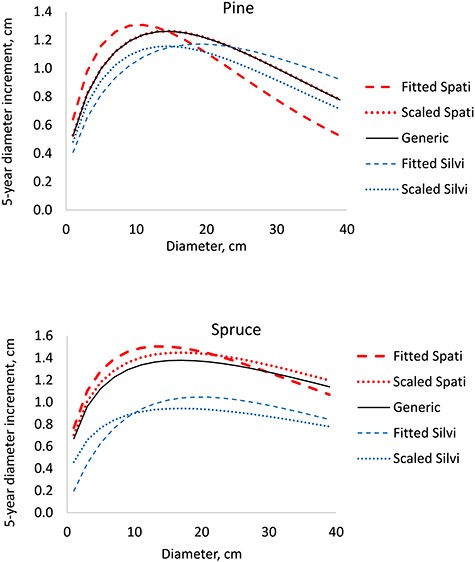
diameter increment models, survival models, ingrowth models
0
¶ Overview
Automated calibration procedures are systematic, software-driven processes that adjust the parameters of measurement, sensing, or predictive models to minimise discrepancies between model outputs and observed real-world data, and they are a critical component of reliable forestry automation and decision-support systems. In forestry applications, models are used for a wide range of purposes — predicting timber volume from remote sensing data, estimating biomass from harvester head measurements, forecasting growth rates from site productivity indices, or classifying land cover from satellite imagery — and the accuracy of these models directly determines the quality of management decisions they inform. Calibration involves comparing model predictions against independently collected reference data (such as manually measured plot data, truck-scale weights, or manually graded timber samples) and then systematically adjusting model coefficients, sensor offsets, or algorithm weights to reduce prediction error. Automated calibration procedures remove the need for manual parameter adjustment by trained specialists, instead using optimisation algorithms — such as least-squares regression, Bayesian updating, or gradient descent — to find the parameter values that best fit the available reference data. In the context of harvester head sensors, for example, automated calibration routines can be triggered whenever a machine arrives at a weighbridge, using the scale weight to recalibrate the onboard volume estimation model without requiring the operator or a technician to manually intervene. This is particularly valuable in Australian forestry operations where machines operate across highly variable wood density profiles (due to species, age class, and moisture content variation) and where the cost of recalibration by specialist technicians is amplified by the remoteness of operations. Frequent automated recalibration ensures that models remain accurate across changing conditions, improving the reliability of production reporting, inventory updates, and quality control systems.
¶ Details
| Field | Value |
|---|---|
| Company | Pukkala et al. |
| Country | University of Eastern Finland |
| Type | Paper |
| Year | 2021 |
| FWPA RD&E | 8.5 |