¶ Nordic Forestry Association (NFA) Advanced Driver Assistance System (ADAS) for forest machines
Recommended Technology
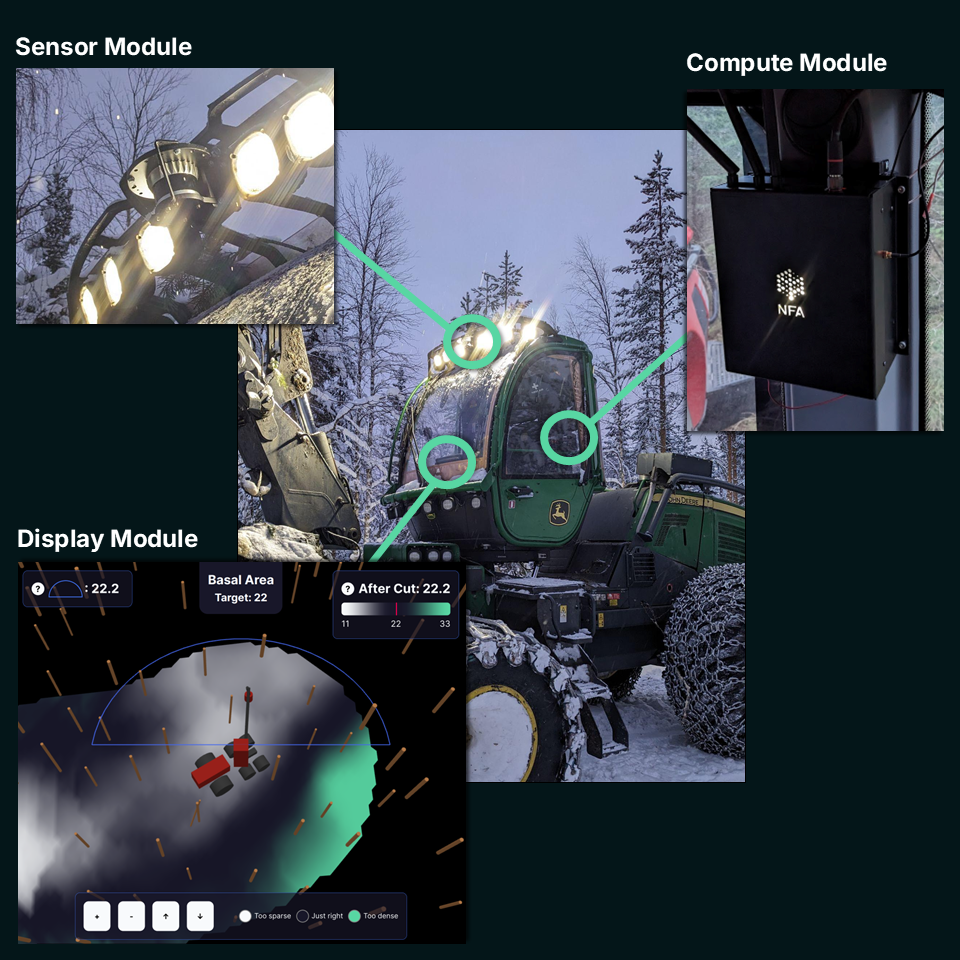
Description: Nordic Forestry Automation (NFA) advanced driver assistance system is an AI‑driven decision support that helps operators deliver accurate, consistent thinning and forest treatments, while keeping full human control of the machine. NFA has developed an advanced driver assistance system (ADAS) for mechanical thinning that brings automotive‑grade perception and AI into the harvester cabin. The system is designed as a retrofit solution for existing harvesters and excavator‑based machines, combining lidar, cameras, GNSS, IMUs, and onboard AI compute to create a real‑time digital map of the forest at individual‑tree resolution. The intent is not autonomy, but decision support - helping operators consistently achieve prescribed thinning outcomes while reducing cognitive load and operator‑to‑operator variability.
In Scandinavia, the NFA system provides live thinning guidance (basal area, stem count, species ratios), strip‑road spacing support, and automatic pre‑ and post‑operation inventory. Each tree cut or retained is logged with centimetre accuracy, enabling auditable compliance reporting and improved downstream planning for forest owners. Large forest companies such as Södra have committed to staged rollout beginning in 2025, following multi‑year pilot programs, and the system has accumulated several thousand hours across multiple machine platforms.
From a technology readiness perspective, NFA’s thinning ADAS sits at approximately TRL 7–8: prototype systems have been extensively tested in operational environments, with early commercial deployment now underway in Sweden and limited international trials, including at least one installation in Australia.
Cost information is not publicly itemised, but industry indications suggest a mid‑five‑figure cost equivalent per machine for hardware and software, plus ongoing support and data services. The value case is driven by improved stand growth, reduced over‑thinning, higher consistency across contractors, and lower training burden for less‑experienced operators, rather than direct labour elimination.
For Australian forests, NFA’s system appears most applicable to plantations and structurally regular native forests where thinning prescriptions can be clearly defined, such as softwood estates or managed eucalypt regrowth. Its reliance on onboard sensing rather than continuous connectivity is advantageous under canopy. However, adaptation would be required for higher species diversity, irregular stand structure, steeper terrain, and different silvicultural objectives compared with Nordic conditions. NFA’s ADAS represents a near‑term, low‑risk augmentation of human operators rather than a disruptive automation leap. In Australia, it offers credible potential to lift thinning quality and consistency in suitable forest types, with moderate cost, manageable integration risk, and a mature technology base.
Category: Autonomous Machinery & Robotics
FWPA RD&E: 4.4
¶ Details
| Company | Country | Type | Website | Available in Australia? | Year | Status | Remarks | TRL | Employees | Colour | Inventors | Patent Model. |
|---|---|---|---|---|---|---|---|---|---|---|---|---|
| Nordic Forestry Automation | Sweden | Company | Link | Green |