¶ Janus Side‑Mounted Modular Battery Swap
Recommended Technology
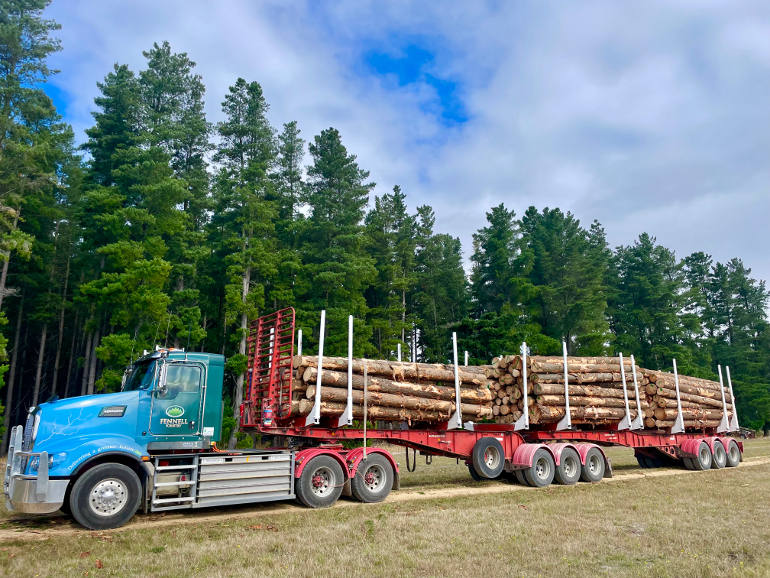
Description: Janus Electric is an Australian‑developed heavy‑vehicle electrification solution that enables rapid battery swapping for Class‑8 trucks, specifically suited to high‑load, regional and industrial transport such as forestry into fully electric trucks using large, containerised battery modules mounted externally behind the cab. Depleted modules are exchanged via a gantry or crane in approximately five minutes, delivering refuelling‑equivalent turnaround times without the need for high‑capacity fast‑charging infrastructure. Batteries are charged off‑vehicle at lower power rates, allowing operations to be located in regions with constrained grid capacity and enabling the use of on‑site renewables.
Janus electric logging trucks were trialled in the Green Triangle forestry region in Australia from 2023 to 2025. The trial was led by Fennell Forestry using a Kenworth T609 diesel prime mover converted to electric by Janus Electric, incorporating a side‑mounted modular battery‑swap system (Green & Brine, 2026).
The trial set out to test three core questions: whether electric drivetrains could meet the torque, payload, and durability demands of log haulage; whether battery swapping could deliver productivity comparable to diesel refuelling; and whether the system could be commercially viable under Australian operating conditions.
From a technical and operational standpoint, the trial was successful. The electric truck demonstrated sufficient torque for heavy log loads, performed reliably on regional forestry routes, and achieved fast (<6 minute battery swaps), enabling continuous operations without the downtime associated with on‑vehicle charging. Driver feedback was positive, particularly in relation to drivability, noise reduction, and power delivery. The trial conclusively showed that battery swapping is essential for heavy forestry applications and that fast‑charging alone is not operationally viable in this context (Green & Brine, 2026).
However, the trial did not scale beyond demonstration due to economic constraints. Real‑world loaded range was closer to 200 km, lower than early projections, reflecting vehicle mass and terrain. Most critically, electricity network demand charges and infrastructure costs made operating costs uncompetitive with diesel, even during periods of elevated fuel prices. Overall, the SA trials proved technical feasibility but economic immaturity, establishing a clear baseline for what must change - energy tariffs, policy settings, and infrastructure models - before broad deployment in the forestry sector becomes viable.
¶ Details
| Company | Country | Type | Website | Available in Australia? | Year | Status | Remarks | TRL | Employees | Colour | Inventors | Patent Model. |
|---|---|---|---|---|---|---|---|---|---|---|---|---|
| Janus | Australia | Link |