¶ Cruiser
| Company | Integral |
| Country | New Zealand |
| Website | https://integral.co.nz/cruiser-inventory-assessment/ |
| Category | Planning & Inventory › Remote sensing & mapping |
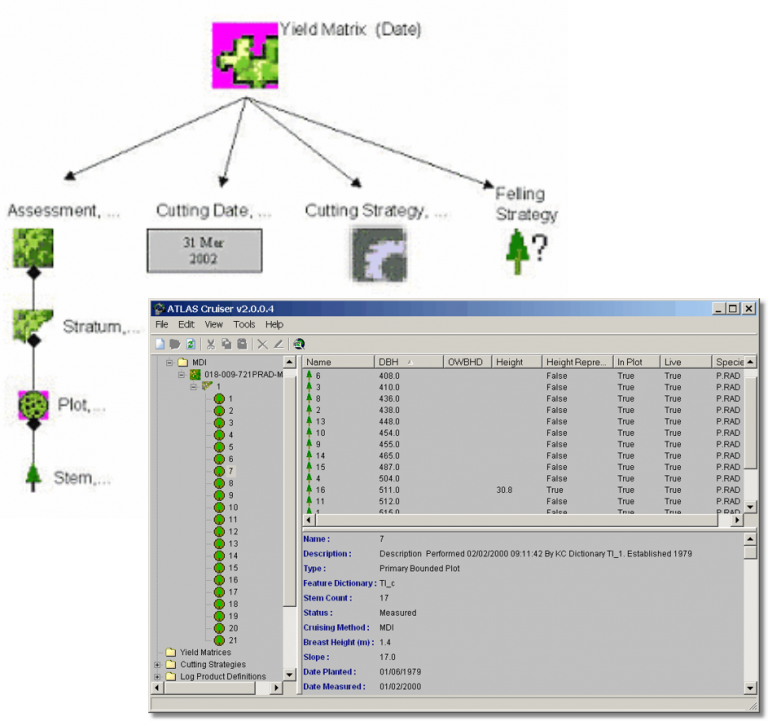
Inventory assesmen
¶ Overview
In forestry, a cruiser (also called a timber cruiser or forest cruiser) is a trained professional — or increasingly, a digital tool or autonomous platform — responsible for conducting timber cruising: the systematic field sampling of a forest stand to estimate merchantable timber volume, species composition, stand basal area, and log quality. Traditional timber cruising involves walking transects or visiting sample plots within a forest block, physically measuring tree parameters such as DBH (using diameter tapes or calipers), total height (using clinometers or hypsometers), form class, and defect percentage, then applying regional volume equations or taper functions to convert these measurements into merchantable volume estimates per hectare. The cruiser's skill lies in combining efficient sampling design with accurate field measurement and sound professional judgement about log quality, breakage, and defect, all of which directly influence the reliability of harvest planning, stumpage valuation, and contractual timber sales. The term "cruiser" is also applied to software tools — such as Haglof's Allegro Field Cruiser platform and various ArcGIS-based mobile applications — that guide field personnel through plot-based data collection, automate volume calculations, and upload records directly to forest management information systems, replacing paper tally sheets and reducing transcription errors. More recently, the concept of the cruiser has expanded to include autonomous or semi-autonomous robotic platforms and UAV-based inventory systems that can conduct timber cruise measurements without human field presence, using sensors such as terrestrial LiDAR, photogrammetric cameras, and hyperspectral imagers to characterise stand structure from fixed plots or along driven transects. In the Australian forest industry, both manual cruising and technology-assisted approaches are used across native hardwood operations in Victoria and Tasmania and plantation softwood operations in New South Wales and South Australia, with the industry progressively shifting toward digital and remote sensing-enhanced cruising methods to reduce field costs and improve inventory accuracy.
¶ Assessment
A capable platform for enhancing inventory and planning accuracy, though its broader risk-reduction benefits remain somewhat limited because evidence of large-scale impact is still qualitative.
¶ Details
| Field | Value |
|---|---|
| Company | Integral |
| Country | New Zealand |
| Type | Company |
| Available in AU? | yes |
| FWPA RD&E | 7.3 |